How Many Anglers Can a Backcountry Charter Take?
Planning a Florida backcountry fishing trip can feel like navigating a maze, especially when you're trying to figure out the logistics for your group. One of the most common questions that comes up is how many people a backcountry charter can actually take out on the water. It’s not just about the legal limit; it’s also about what makes for a truly enjoyable and productive fishing experience, and this guide will break down everything you need to know to ensure your trip is a success.
Understanding Florida Backcountry Charters
Backcountry fishing in Florida is a unique and incredibly rewarding experience. It's not your typical deep-sea adventure; instead, it takes you into the shallow, intricate ecosystems of the state's coastlines. But this specialized environment also dictates the kind of boats used and, consequently, how many anglers can comfortably (and legally) fit on board.
What Makes a Backcountry Charter Unique?
When we talk about a backcountry charter, we're envisioning a particular style of fishing that happens in very specific environments. Think expansive grass flats, winding mangrove tunnels, secluded bays, and shallow estuaries. These are the nurseries and hunting grounds for some of Florida's most sought-after inshore species like redfish, snook, and spotted seatrout, and of course, the mighty tarpon during their migrations. The beauty of it lies in the intimate connection with nature, often sight-fishing in crystal-clear skinny water where you can literally see the fish before you cast.
To navigate these delicate, shallow areas, backcountry guides employ specialized vessels: primarily flats boats and technical poling skiffs. These boats are designed to be light, stealthy, and have a very shallow draft, meaning they sit high in the water and can glide over mere inches of water without disturbing the bottom or spooking fish. They often feature casting platforms at the bow and stern, and a poling platform for the guide to silently propel the boat with a long pole, giving anglers the best chance at an unpressured shot at a trophy fish. This focus on stealth and shallow water access inherently limits their size and, subsequently, the number of people they can comfortably accommodate.
The "Six-Pack" Rule and US Coast Guard Regulations
Now, let's get down to the nitty-gritty of the legalities, because this is where a lot of confusion often creeps in. In the United States, any vessel carrying passengers for hire is regulated by the U.S. Coast Guard (USCG). For recreational fishing charters, there's a very important distinction based on capacity. Most smaller charter boats, including nearly all backcountry and inshore guides, operate under what's affectionately known as a "six-pack" license, or more formally, an OUPV (Operator of Uninspected Passenger Vessels) license.
This USCG license permits a captain to carry a maximum of six paying passengers (not including the captain and any crew) on uninspected vessels. The reason for this rule is rooted in safety regulations. Vessels carrying more than six passengers require a different, more stringent USCG inspection and certification process, which often applies to larger head boats or party boats you might see at major marinas. This "six-pack" rule is a fundamental aspect of recreational fishing charters nationwide, and Florida is no exception. So, while your guide might be an absolute wizard on the water, they are legally bound by this passenger limit. It's designed to ensure that smaller vessels don't get overcrowded, compromising safety and the overall experience. When you're browsing for a charter, whether through a local guide's website or a booking platform like FishingBooker, you'll find that most inshore and backcountry options clearly state their maximum capacity, and it will almost always be six passengers or fewer.
Typical Angler Capacity on Florida Backcountry Boats
While the USCG "six-pack" rule sets the legal maximum at six passengers, the comfortable and optimal number of anglers for a productive backcountry trip is often much lower. This is where the practical realities of fishing from a specialized shallow-water craft come into play.
Standard Flats Boats and Skiffs
The quintessential backcountry vessel is the flats boat or technical poling skiff. These boats are purpose-built for navigating extremely shallow water with minimal disturbance. They typically range from 16 to 20 feet in length, are relatively narrow, and have open decks with elevated casting platforms. While a captain could legally take six passengers on a larger flats boat, it's rarely recommended for a quality fishing experience.
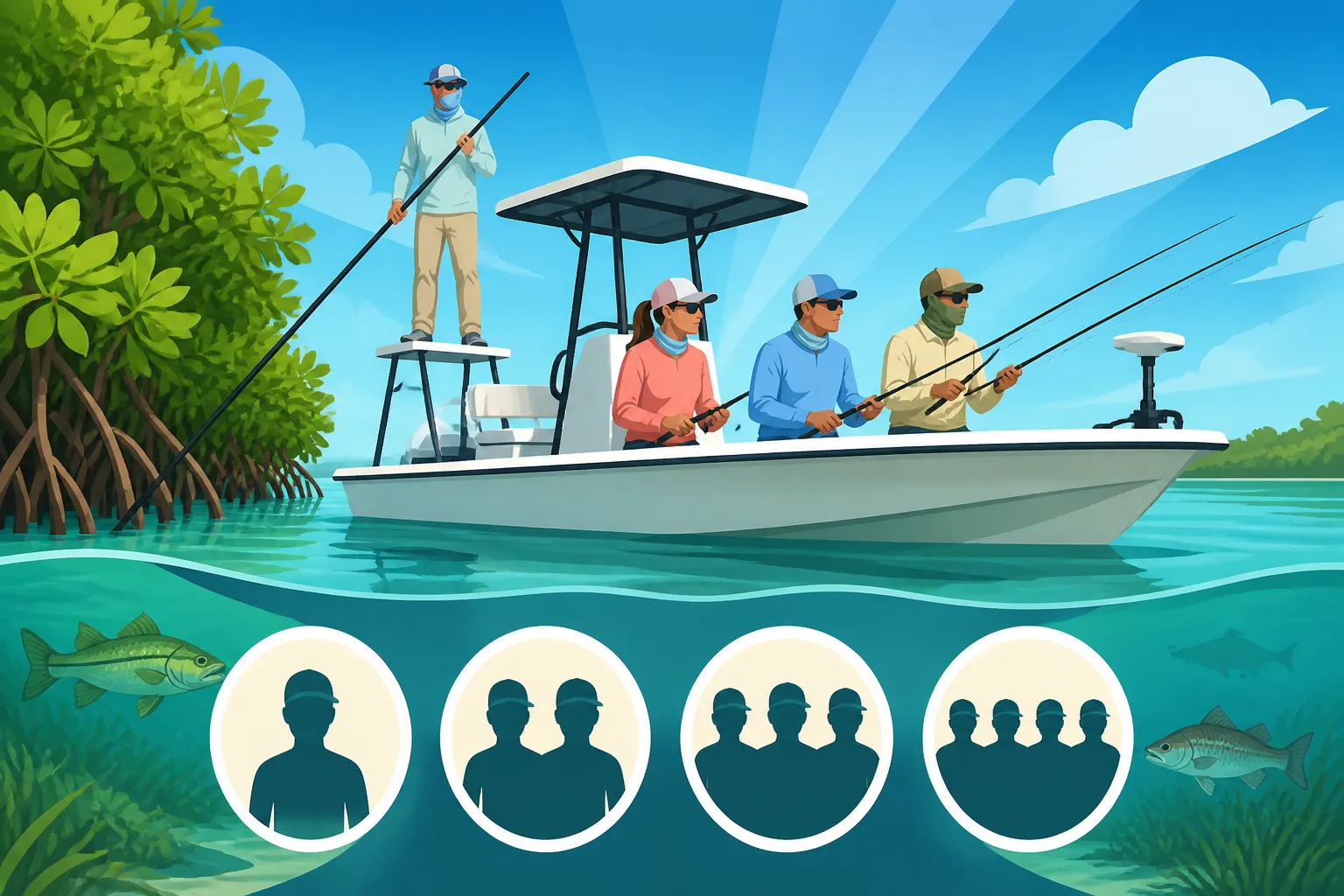
Imagine a typical flats boat with a guide poling from the stern. The optimal setup for sight-fishing in the bow is usually one angler, maybe two if they are very comfortable and coordinated. Any more than that, and you start running into issues with casting space, line tangles, and the sheer logistics of moving around the boat, especially when trying to stay stealthy. For a truly immersive backcountry experience – stalking redfish on the flats or patiently waiting for a snook to emerge from the mangroves – two anglers is generally considered the sweet spot. Three can work if everyone is experienced and understands the space limitations, but beyond that, the fishing becomes significantly more challenging for all involved. The guide's ability to provide individual attention, coaching, and untangle lines also diminishes rapidly with more people.
Bay Boats and Larger Vessels
There's a subtle but important distinction between a true flats boat and a bay boat, and understanding this can help manage expectations regarding angler capacity. Bay boats are generally larger, typically 20 to 26 feet, wider, and have a deeper V-hull. They are designed to handle slightly choppier bay waters more comfortably and often have more storage and seating. While they can access many backcountry areas, they usually can't get into the absolute skinny water that a dedicated flats skiff can.
Because of their increased size, bay boats can often accommodate three to four anglers more comfortably for certain types of fishing, such as drifting with live bait or bottom fishing in slightly deeper channels within the backcountry. They still adhere to the USCG "six-pack" rule, meaning a maximum of six passengers. However, even on a bay boat, once you hit five or six anglers, the deck can feel crowded, and casting opportunities might be limited. If you're planning a trip for a larger family or group of friends (say, 4-6 people), a bay boat might be a more practical choice than a flats boat, offering more space without sacrificing too much access to the broader backcountry environment. Just be aware that the super skinny water spots might be out of reach.
Factors Influencing Angler Comfort and Experience
It's one thing to be legally allowed on a boat; it's another entirely to have an enjoyable and effective fishing trip. The number of anglers on a backcountry charter dramatically impacts several aspects of the experience, from physical comfort to fishing success.
Space, Casting Room, and Guide Attention
Think about the dynamics of fishing. You need room to cast, to move around when fighting a fish, and to retrieve your line without snagging your buddy's ear. On a typical flats boat, there's usually a dedicated casting platform at the bow. With one angler up front, they have ample space to make accurate casts, change angles, and work their lure effectively. Add a second angler, and suddenly that space is shared. Both anglers need to be mindful of each other, and casting often becomes more restricted. How to Fish a New Spot You've Never Tried might seem basic, but it becomes even more critical when space is at a premium.
More anglers also mean more rods, more tackle bags, and simply more bodies in a relatively small area. This can lead to increased noise, which can spook fish in shallow water, and a higher chance of tangled lines, which eats into valuable fishing time. Crucially, a guide’s attention is finite. With one or two anglers, the guide can offer personalized instruction, spot fish for each person, and quickly assist with snags or re-tying. With more people, that individual attention gets diluted, making it harder for beginners to learn and for experienced anglers to maximize their opportunities. If you're targeting elusive species like Florida Snook Fishing Guide or Florida Tarpon Fishing Guide, where every cast counts, minimizing distractions and maximizing guide interaction is paramount.
Type of Fishing and Target Species
The specific fishing techniques and the species you're targeting also play a huge role in determining the ideal number of anglers. For instance, fly fishing requires significantly more casting room than spin fishing. A fly line needs space to unfurl behind the angler without hitting anything or anyone, making fly casting with more than two people (and often just one) on a flats boat nearly impossible to do effectively or safely. Fly Fishing License Rules in Florida are the same, but the practicalities of the technique differ greatly.
Similarly, if your goal is sight-fishing for spooky redfish on shallow grass flats, stealth is key. More people on the boat generally translate to more movement, more noise, and a higher chance of sending those wary fish scurrying away. Conversely, if the plan involves anchoring up and soaking baits for mangrove snapper or casting along a channel for smaller species, where movement and pinpoint casting aren't as critical, a slightly larger group might be more manageable. Even then, the general rule of thumb holds: fewer anglers usually equates to a more focused and potentially more successful outing, especially for the nuanced fishing found in the backcountry.
The Importance of Communication with Your Captain
Given these variables, the absolute best thing you can do when planning a backcountry fishing trip is to communicate openly and honestly with your prospective captain. Don't just assume what's best; ask! Reputable captains, whether you find them through word-of-mouth or platforms like FishingBooker, will be transparent about their boat's practical capacity and what kind of experience to expect with different group sizes.
For example, if you have a group of four experienced anglers who are comfortable with each other and primarily want to spin fish, a captain might say their bay boat could handle it, though you might have to take turns on the casting deck. If you're four novices hoping to fly fish, they'll likely recommend splitting into two boats. They know their vessel and the local waters intimately, and their goal is to ensure you have a safe and memorable trip. Be upfront about your group size, your experience level, and what you hope to catch. This allows the captain to set realistic expectations and recommend the best setup, even if it means suggesting two separate charters if your group is larger. For a truly smooth booking experience, consider platforms like FishingBooker, which often include direct messaging features to discuss these details before you commit.
| Boat Type | Typical Length (feet) | Ideal Angler Capacity (Comfort/Effectiveness) | Max Angler Capacity (USCG "Six-Pack") | Best For | Considerations |
|---|---|---|---|---|---|
| Technical Poling Skiff | 16-18 | 1 | 6 | Extreme skinny water, stealthy sight-fishing | Very limited space, best for solo angler or very coordinated duo, often fly fishing. |
| Standard Flats Boat | 18-20 | 1-2 | 6 | Shallow flats, mangroves, sight-fishing | Good for duo, can be tight with 3, challenging with more. Casting room is key. |
| Bay Boat | 20-26 | 2-4 | 6 | Larger bays, deeper channels, light chop | More space, can handle 3-4 comfortably, less access to ultra-skinny water. |
| Center Console (Smaller) | 20-25 | 2-4 | 6 | Nearshore, larger bays, light offshore | More versatile, but often less specialized for true backcountry stealth. |
Planning Your Backcountry Trip for Optimal Enjoyment
Once you understand the practicalities and legal limits, you can make informed decisions to ensure everyone in your party has a fantastic time on the water. It’s all about matching your expectations to the reality of the vessel and the fishing environment.
Solo, Duo, or Small Group: Finding the Sweet Spot
For Florida backcountry fishing, especially if you're looking for that pristine, sight-fishing experience in shallow water for species like Florida Redfish Fishing Guide or Florida Tarpon Fishing Guide, the sweet spot for anglers is typically one to two people.
- One Angler: This is the ultimate experience. You get the guide's undivided attention, maximum casting room, and the boat remains as stealthy as possible. It's perfect for honing skills or targeting a specific trophy.
- Two Anglers: This is still an excellent option and very common. You share the experience with a friend or partner, and there’s usually enough room to take turns on the casting deck. Communication and coordination are helpful but manageable. The guide can still provide ample instruction and assist both anglers effectively.
- Three Anglers: This can work, particularly on a slightly larger flats boat or if everyone is experienced, casts well, and understands the space constraints. You might have to rotate who's actively casting on the front deck, and there will be less individual attention from the guide. Expect a bit more closeness, and keep your elbows in!
- Four or More Anglers: On a traditional flats boat or even many bay boats, pushing four or more anglers significantly compromises the quality of a backcountry fishing experience focused on sight-fishing and stealth. While legally permissible up to six, it often leads to tangles, frustration, limited casting opportunities, and a less personal interaction with the guide. This is where you might need to reconsider your approach.
If your primary goal is the unique challenge and serenity of true backcountry fishing, prioritizing a smaller group will almost always lead to a more memorable and successful trip. Don't forget to ask about Florida Fishing License Age Requirements and Who Needs a Fishing License in Florida for each member of your party before the trip!
Alternatives for Larger Groups
So, what if you have a larger group of five or six friends or family members who all want to fish? Don't despair! There are still excellent options to explore Florida's waters.
- Book Multiple Boats/Guides: This is hands-down the best solution for groups larger than three or four who want a dedicated backcountry experience. By hiring two separate captains, each with their own flats boat or bay boat, you can divide your group, ensuring everyone gets plenty of space, personalized attention, and a top-notch fishing experience. Many guides work in tandem and can coordinate multi-boat trips. This might sound like more expense, but the quality of the fishing and the individual enjoyment will be exponentially higher than trying to cram everyone onto one vessel. You can often find guides with availability for multiple boats through a reputable booking service like FishingBooker.
- Consider a Larger Vessel for Different Fishing: If the hardcore backcountry experience isn't the absolute priority, but rather getting out on the water and catching some fish is, you might look into other types of charters. For instance, a larger bay boat or nearshore center console might accommodate five or six anglers for reef fishing, bottom fishing, or trolling slightly offshore in areas that are still considered relatively close to shore. However, these will be different fishing styles and environments than the shallow-water backcountry.
- Party Boats (Head Boats): For very large groups (7+ passengers) or those on a budget, a party boat (also known as a head boat) is an option. These are much larger vessels that can carry dozens of passengers, often for half-day bottom fishing trips in deeper waters. While you'll definitely catch fish and it's a social atmosphere, it's a completely different experience from a private backcountry charter. Party Boat Fishing Cost in Florida is typically per person, making it an accessible option, but you trade intimacy and targeted species for sheer numbers and a general fishing outing. Just remember, these typically target different species and depths than a backcountry guide would.
Ultimately, the goal is to align the number of anglers with the type of fishing and the vessel to maximize everyone's enjoyment. Don't hesitate to research and ask questions about Florida Charter Boat Fishing License Rules and what to bring on your chosen charter to be fully prepared for your Florida adventure.
Disclaimer
This article is for general informational purposes only and does not constitute professional advice. Laws, prices and regulations vary by location and change over time. Consult a qualified professional for guidance on your specific situation.