Florida Fishing License Cost Compared to Alabama
Planning a fishing trip to Florida or Alabama, or maybe even hopping between the two, can be a fantastic adventure. But let's be real, the last thing you want to deal with is a nasty surprise at the bait shop counter or, worse, a run-in with a wildlife officer because you misunderstood the license rules. Navigating the different fishing license costs and requirements between states can feel like trying to untangle a backlash on your reel – frustrating and confusing. This guide is here to untangle all that for you, offering a clear comparison of fishing license costs in Florida versus Alabama, so you can focus on catching fish, not headaches.
Understanding the Different Structures of Fishing Licenses
Before we dive into the nitty-gritty of dollars and cents, it’s crucial to understand that both Florida and Alabama, like most states, structure their fishing licenses based on a few key factors. These factors directly influence how much you'll pay and what kind of fishing you're authorized to do. It’s not just a one-size-fits-all kind of deal, and recognizing these differences is the first step in avoiding any unexpected costs.
Resident Versus Non-Resident Distinctions
This is perhaps the biggest differentiator in license pricing, and it makes perfect sense when you think about it. States tend to offer significant discounts to their residents because residents already contribute to the state's conservation efforts and infrastructure through taxes. For folks who call Florida home, you’ll find that a Florida Resident Fishing License Rules guide exists for a reason – your rates are generally much lower than for someone just visiting. The same applies in Alabama.
To qualify for resident rates in Florida, you generally need to have lived in the state for at least six continuous months and provide proof of residency, like a Florida driver's license, voter registration, or declaration of domicile. For students attending a Florida college, there are often provisions to qualify as a resident, even if your permanent address is elsewhere. Similarly, Alabama requires proof of residency, usually a valid Alabama driver’s license or other state-issued identification, to ensure you've been living there for the required period, typically 90 days or more. This distinction is vital because non-resident licenses are almost always significantly more expensive, reflecting the fact that visitors aren't contributing to the state's long-term conservation funding in the same way residents are.
Freshwater, Saltwater, and Combination Options
Another critical distinction lies in the type of water you plan to fish. Both Florida and Alabama are blessed with incredible fishing opportunities in both freshwater and saltwater environments. However, the licenses for these environments are often separate, or available as a combination.
In Florida, you'll find distinct licenses for freshwater fishing (think bass in Lake Okeechobee or crappie in the St. Johns River) and saltwater fishing (like redfish in Tampa Bay or snapper offshore). Many anglers opt for a combination license, which covers both environments and often provides a slight cost saving compared to buying two separate annual licenses. This system allows the Florida Fish and Wildlife Conservation Commission (FWC) to direct funds specifically to the conservation efforts most relevant to each ecosystem. If you're planning a trip where you might hit the lakes one day and the coast the next, a combination license is usually the most convenient and cost-effective route, as detailed in our guide on Florida Combination Freshwater and Saltwater License Cost.
Alabama operates on a similar principle. You’ll need either a freshwater fishing license, a saltwater fishing license, or you might find a broader "All-Game" license that bundles hunting and fishing, though dedicated fishing-only combos aren't as common as in Florida. The Alabama Department of Conservation and Natural Resources (ADCNR) also uses these divisions to manage and fund its diverse fisheries. Understanding your primary target species and location will help you decide which specific license or combination makes the most sense for your trip. Don't just assume one covers all!
A Deep Dive into Florida's Fishing License Costs
Florida is a fishing paradise, and the good news is that obtaining a license is a straightforward process, whether you're a long-time resident or just visiting for a week. The cost, however, varies quite a bit depending on your residency and how long you plan to fish. It's always a good idea to check the official GoOutdoorsFlorida website for the most current pricing, but let's break down the general structure you can expect. For a broader overview, you can always check our Florida Fishing License Guide.
Florida Resident License Costs
For those lucky enough to call the Sunshine State home, the fishing license costs are relatively modest, especially when considering the sheer abundance and diversity of fishing opportunities available year-round.
- Annual Freshwater Fishing License: This will set a resident back around $17.00. It's an incredible value for a full year of fishing in Florida's vast network of lakes, rivers, and canals.
- Annual Saltwater Fishing License: Similar to freshwater, an annual saltwater license for residents is also about $17.00. This covers fishing from shore, piers, kayaks, and private boats in Florida's extensive coastal waters. If you're a resident planning on some Florida Shoreline Fishing License Explained, this is what you'll need.
- Annual Freshwater/Saltwater Combination License: For the best of both worlds, a resident combo license is approximately $32.50. This is usually the go-to option for serious Florida anglers who don't want to be restricted to one type of water.
- Five-Year Licenses: Florida also offers 5-year licenses for residents, which can save you a bit of money over time and the hassle of annual renewal. A 5-year freshwater license is around $79.00, and a 5-year saltwater license is also about $79.00. The 5-year freshwater/saltwater combination is roughly $159.00.
- Specific Permits: Beyond the base license, if you plan to target specific species like Snook or Lobster, you'll need additional permits. A Snook Permit costs about $10.00, and a Lobster Permit is approximately $5.00, both of which are added to your saltwater or combo license. These are crucial for compliance, as detailed in our Florida Snook Permit Requirements post.
- Exemptions: It's worth noting that Florida offers several exemptions. For instance, residents over 65 might qualify for a free Florida Resident Senior Citizen Hunting and Fishing Certificate, and disabled residents may also have Florida Fishing License Discounts for Disabled Residents. These programs make fishing accessible to more people, which is fantastic.
Florida Non-Resident License Costs
Visiting Florida is a dream for many anglers, and the state makes it easy to get out on the water, even for a short trip. However, non-resident licenses are priced higher to reflect the fact that visitors typically don't contribute to state conservation funds through other taxes.
- Annual Freshwater Fishing License: A full year of freshwater fishing for a non-resident runs about $47.00.
- Annual Saltwater Fishing License: An annual saltwater license for non-residents also costs around $47.00.
- Annual Freshwater/Saltwater Combination License: If you're visiting for an extended period and want to experience both, the non-resident combination license is approximately $79.00.
- Short-Term Options: This is where Florida really caters to tourists.
- 3-Day Freshwater License: Around $17.00.
- 7-Day Freshwater License: Approximately $30.00.
- 3-Day Saltwater License: Around $17.00.
- 7-Day Saltwater License: Approximately $30.00.
These short-term options are perfect for a vacation, allowing you to get a taste of Florida's incredible fishing without committing to an annual license. Many visitors find these to be excellent value for money, especially if they are staying for a week or less, as discussed in our Florida Nonresident Fishing License Rules guide.
Exploring Alabama's Fishing License Costs
Just to Florida's west, Alabama offers its own unique and abundant fishing experiences, from the vast Mobile Bay to the inland lakes and rivers. Like Florida, Alabama’s Department of Conservation and Natural Resources (ADCNR) manages its licenses with different rates for residents and non-residents, and for freshwater versus saltwater. It's essential to understand these distinctions to ensure you're properly licensed for your Alabama angling adventure.
Alabama Resident License Costs
For residents of Alabama, the license fees are designed to be affordable, encouraging participation in the state's rich fishing traditions while funding essential conservation programs.
- Annual Freshwater Fishing License: An Alabama resident can purchase an annual freshwater license for approximately $14.50. This covers all the fantastic bass lakes, catfish rivers, and panfish opportunities the state has to offer, from Lake Guntersville down to the Mobile-Tensaw Delta.
- Annual Saltwater Fishing License: For those looking to fish Alabama's Gulf Coast, including Mobile Bay, Perdido Bay, and out into the Gulf of Mexico, an annual resident saltwater license costs around $24.80. This gives you access to a wide array of species like speckled trout, redfish, flounder, and snapper.
- Combination Options: Alabama doesn't typically offer a single "fishing only" freshwater and saltwater combination license in the same way Florida does. Instead, residents often find combination licenses that include hunting, such as an "All-Game" license for approximately $36.25, which also includes a freshwater fishing license. If you only fish, you'd generally buy the separate freshwater and/or saltwater licenses.
- Lifetime Licenses: For long-term savings and convenience, Alabama offers lifetime fishing licenses for residents, with prices varying by age at the time of purchase. For example, a lifetime freshwater license could be around $200.00 for adults, with lower rates for youth and seniors. These are a fantastic investment for avid anglers, ensuring they're covered for life without worrying about annual renewals.
- Special Requirements: While not part of the base license, anglers targeting Red Snapper in federal waters during open season will need a free "Gulf Reef Fish Endorsement" in addition to their saltwater license, which helps the state track participation in that specific fishery. This is something to be aware of if offshore fishing is on your agenda.
Alabama Non-Resident License Costs
Alabama welcomes anglers from out of state with open arms, but as expected, non-resident license fees are higher. These costs reflect the non-resident's temporary use of state resources and their contribution to maintaining healthy fish populations and habitats.
- Annual Freshwater Fishing License: A non-resident looking to fish Alabama's freshwaters for a full year will pay approximately $56.60.
- Annual Saltwater Fishing License: An annual saltwater license for non-residents is about $59.20, granting access to the state's productive coastal fisheries.
- Short-Term Options: Alabama provides excellent flexibility for visitors with several short-term non-resident license options, which can be very cost-effective for shorter trips.
- 3-Day Freshwater Fishing License: This costs around $32.65.
- 7-Day Freshwater Fishing License: This costs approximately $41.35.
- 3-Day Saltwater Fishing License: This option is about $34.50.
- 7-Day Saltwater Fishing License: This comes in at roughly $42.25.
These short-term licenses are highly popular among tourists and those making quick fishing excursions into Alabama, providing a good balance between access and affordability for a limited time.
Direct Comparison: Florida Versus Alabama Pricing
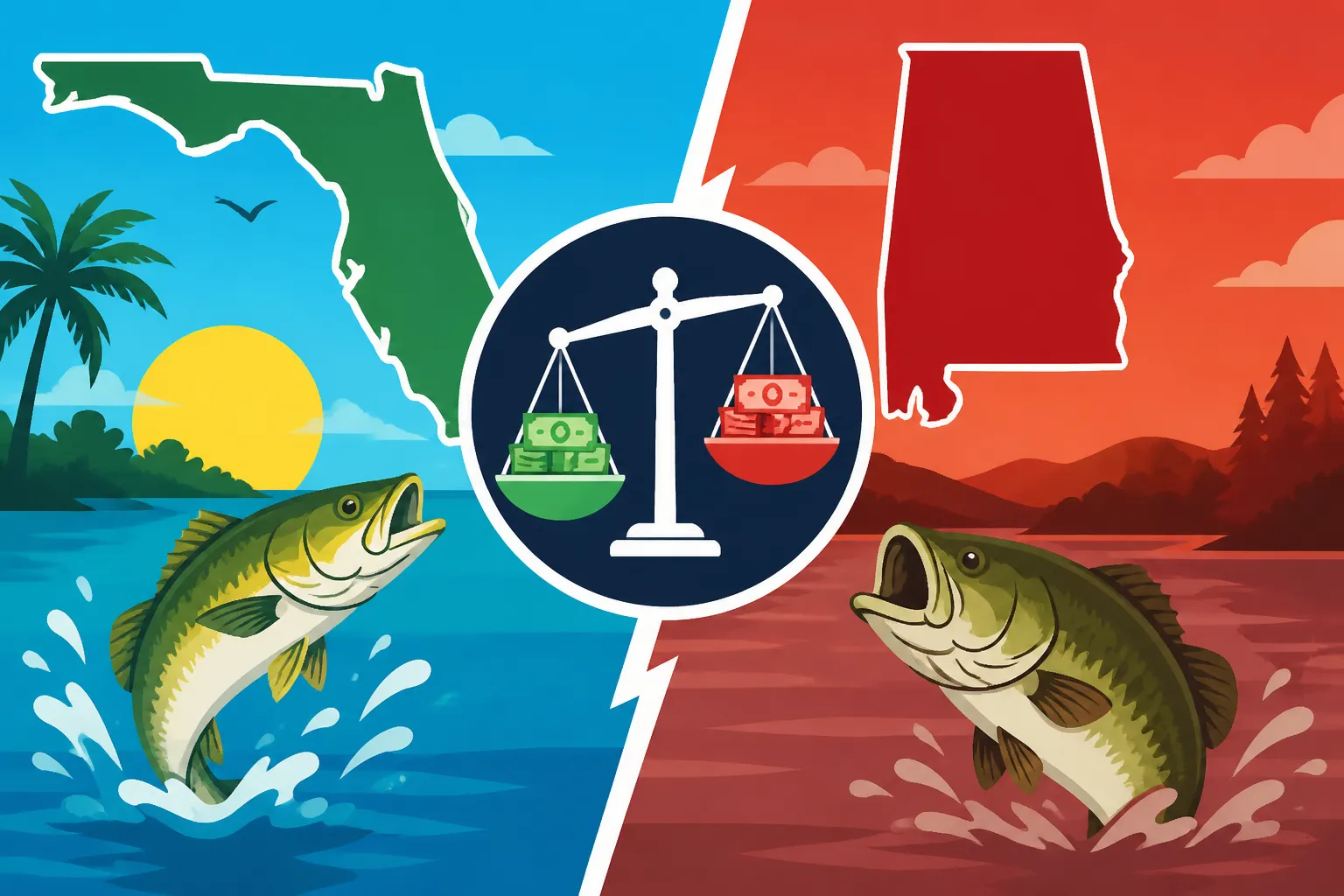
Now, let's get down to the numbers you've been waiting for. Comparing the actual costs side-by-side reveals some interesting differences and helps you budget accurately, whether you're focusing on one state or planning a multi-state fishing adventure. This comparison often highlights why it's so important to be clear on your residency and the type of fishing you plan to do.
Annual Resident License Comparison
When it comes to annual licenses for residents, both states offer very reasonable pricing, especially given the quality of fishing.
- Freshwater: Florida's resident annual freshwater license is $17.00, while Alabama's is $14.50. So, Alabama is slightly less expensive for resident freshwater anglers.
- Saltwater: For saltwater, Florida residents pay $17.00 annually, whereas Alabama residents pay $24.80. In this case, Florida comes out as the more affordable option for saltwater residents.
- Combination/Comprehensive: Florida offers a dedicated resident annual freshwater/saltwater combination for $32.50. Alabama doesn't have a direct fishing-only combo; residents would typically purchase separate freshwater ($14.50) and saltwater ($24.80) licenses, totaling $39.30 for both. So, Florida's resident combo license offers a noticeable saving if you plan to fish both environments.
Annual Non-Resident License Comparison
For non-residents, the prices naturally go up in both states, but the differences become more pronounced.
- Freshwater: Florida's non-resident annual freshwater license is $47.00, compared to Alabama's $56.60. Florida is cheaper for non-resident annual freshwater fishing.
- Saltwater: A non-resident annual saltwater license in Florida costs $47.00, while in Alabama, it's $59.20. Again, Florida offers a lower price for non-resident annual saltwater access.
- Combination/Comprehensive: Florida's non-resident annual freshwater/saltwater combination license is $79.00. In Alabama, buying both non-resident annual freshwater and saltwater licenses separately would cost $56.60 + $59.20 = $115.80. Florida's combo is significantly more cost-effective for non-residents who want to fish both fresh and saltwater for a full year.
Short-Term Non-Resident License Value
This is often where visitors spend the most time comparing. For a quick trip, short-term licenses are invaluable.
- 3-Day Freshwater: Florida is $17.00, Alabama is $32.65. Florida is considerably cheaper.
- 7-Day Freshwater: Florida is $30.00, Alabama is $41.35. Florida maintains its lead in affordability.
- 3-Day Saltwater: Florida is $17.00, Alabama is $34.50. Florida is nearly half the price.
- 7-Day Saltwater: Florida is $30.00, Alabama is $42.25. Florida is still the more budget-friendly choice.
From these comparisons, it's clear that Florida generally offers more competitive pricing for both resident combination licenses and all non-resident options, particularly for short-term visits. Alabama's resident freshwater license is slightly cheaper, but Florida's overall structure seems designed to provide more value, especially for those looking to experience both fresh and saltwater or for out-of-state visitors.
Here’s a handy table to summarize the core costs:
| License Type | Florida (Approx. Cost) | Alabama (Approx. Cost) |
|---|---|---|
| Resident Annual Freshwater | $17.00 | $14.50 |
| Resident Annual Saltwater | $17.00 | $24.80 |
| Resident Annual Combo (FW/SW) | $32.50 | N/A (separate licenses) |
| Non-Resident Annual Freshwater | $47.00 | $56.60 |
| Non-Resident Annual Saltwater | $47.00 | $59.20 |
| Non-Resident Annual Combo (FW/SW) | $79.00 | N/A (separate licenses) |
| Non-Resident 3-Day Freshwater | $17.00 | $32.65 |
| Non-Resident 7-Day Freshwater | $30.00 | $41.35 |
| Non-Resident 3-Day Saltwater | $17.00 | $34.50 |
| Non-Resident 7-Day Saltwater | $30.00 | $42.25 |
| Florida Snook Permit | $10.00 (additional) | N/A |
| Florida Lobster Permit | $5.00 (additional) | N/A |
Note: Prices are approximate and subject to change. Always verify current costs on official state wildlife agency websites.
Practical Considerations and Where to Buy
Getting your fishing license should be the easiest part of your trip planning. Both Florida and Alabama have made it incredibly convenient to purchase licenses, ensuring you spend more time fishing and less time worrying about bureaucracy. However, knowing your options can save you a last-minute scramble.
Online and In-Person Purchase Options
Thankfully, in today's digital age, buying a fishing license is often just a few clicks away. Both states prioritize easy access for anglers.
- Online:
- Florida: The Florida Fish and Wildlife Conservation Commission (FWC) operates the GoOutdoorsFlorida website, which is the most popular and convenient way to purchase your license. It’s intuitive, secure, and you can print your license right from home or store it digitally on your phone via their app. This is often the best option to quickly get a Florida Fishing License Costs and Fees updated.
- Alabama: Similarly, the Alabama Department of Conservation and Natural Resources (ADCNR) has its Outdoor Alabama website. Here, you can easily navigate through the options, select your desired license, and complete your purchase online. Like Florida, you'll get an immediate confirmation that serves as your temporary license, and you can keep it on your phone or print it out.
- In-Person: If you prefer a more traditional approach or need to ask a question, both states offer numerous physical locations where you can buy a license.
- Retailers: Large outdoor retailers like Bass Pro Shops, Cabela's, and even big-box stores like Walmart usually have departments where you can purchase fishing licenses. Many local bait and tackle shops throughout Florida and Alabama also serve as authorized license agents. These spots are great for grabbing some last-minute bait or gear, too, and you can often find a good selection of fishing essentials, maybe even a new tackle box you found on Amazon. If you're wondering Where to Buy a Florida Fishing License Near You, these are excellent starting points.
- County Tax Collectors/License Agents: In Florida, you can also purchase licenses at county tax collector's offices. In Alabama, various probate offices and other designated license agents across the state can assist you. This is particularly useful if you have specific questions about residency or unique situations that might not be easily addressed online.
When purchasing online, always make sure you’re on the official state agency website to avoid third-party vendors who might charge extra fees. Remember, most official platforms will allow you to quickly retrieve a lost license or verify your purchase history, which is a huge peace of mind.
Additional Permits and Endorsements
The base fishing license covers the general act of fishing, but some specific activities or species might require an extra permit or endorsement. This is another area where Florida and Alabama have different approaches.
- Florida's Specific Permits: As mentioned earlier, if you plan to specifically target snook, you'll need a Snook Permit, which costs an additional $10.00 on top of your saltwater or combo license. Similarly, for the thrill of harvesting spiny lobster, a Lobster Permit for $5.00 is mandatory. These permits help the FWC monitor and manage these highly sought-after species, ensuring their sustainability. If you're getting serious about these specific species, our Florida Lobster Permit Requirements guide has all the details.
- Alabama's Endorsements: While Alabama doesn't have as many separate species-specific permits as Florida, it does require a "Gulf Reef Fish Endorsement" for anglers harvesting reef fish, including Red Snapper, in federal waters. This endorsement is currently free but still required and must be obtained in addition to your Alabama saltwater license. It's a critical tool for the ADCNR to gather accurate catch data for federal stock assessments. If you're headed offshore from Gulf Shores or Orange Beach with dreams of a big snapper, make sure you've got this covered.
These additional requirements underscore the importance of checking the regulations specific to your target species and fishing grounds. A little research upfront can save you from a citation and ensure you're contributing correctly to the conservation efforts that keep both Florida and Alabama's fisheries thriving. For general information on what else might be needed, our broader Florida Fishing Regulations and Bag Limits resource can be very helpful.
Disclaimer
Please remember that fishing regulations and license costs can change. Always consult the official Florida Fish and Wildlife Conservation Commission (FWC) and Alabama Department of Conservation and Natural Resources (ADCNR) websites or offices for the most current and accurate information before planning your fishing trip. This guide provides general information and approximate costs.