Florida Fishing License Cost Compared to Georgia
Navigating the world of fishing licenses can feel like trying to untangle a particularly stubborn fishing knot, especially when you're planning a trip that might span state lines. Many anglers find themselves scratching their heads, wondering if they're better off heading to the Sunshine State or making a quick trip up to the Peach State for their angling adventures. This guide is here to untangle that knot for you, breaking down the often-confusing costs and structures of Florida and Georgia fishing licenses so you can spend less time calculating and more time casting.
Understanding Florida's Fishing License Structure
Ah, Florida, the land of endless fishing opportunities! But with those opportunities comes a licensing system that can feel a bit like a maze if you're not prepared. The biggest thing to wrap your head around is that Florida historically splits its fishing licenses into freshwater and saltwater categories, with different costs and rules for each. This can be a real surprise for folks coming from states where a single license covers everything.
Resident vs. Non-Resident Licenses
Let's be real, residency makes a huge difference in Florida. If you've been lucky enough to call Florida home for at least six continuous months and can prove it with proper documentation (like a Florida driver's license or voter registration), you're eligible for significantly reduced rates. This is a common practice across states, but the price gap in Florida for an annual license is pretty substantial, making it a sweet deal for locals. For instance, an annual resident saltwater license is quite affordable, a stark contrast to what our out-of-state friends pay. Knowing the Florida Resident Fishing License Rules is crucial before you head to the license vendor.
On the other hand, if you're visiting Florida for a vacation, a seasonal stay, or just passing through, you'll need to purchase a non-resident license. These are naturally more expensive, reflecting the fact that you haven't contributed to the state's tax base that helps fund conservation efforts. It's a fair system, but it's definitely something to budget for if you're not a Florida resident. Understanding the specifics of Florida Nonresident Fishing License Rules is key for visitors.
Freshwater vs. Saltwater vs. Combination
This is where many newcomers get tripped up. Florida doesn't have a universal "fishing license" that covers all waters. Instead, you need to decide if you're going to be fishing in freshwater, saltwater, or both.
- Freshwater Fishing Licenses: These cover fishing in Florida's vast network of lakes, rivers, and ponds. Think bass fishing on Lake Okeechobee or chasing crappie in the St. Johns River. If your dream trip involves reeling in a trophy largemouth bass, this is the license you'll need. The cost for a resident annual freshwater license is quite reasonable, designed to make this accessible to everyone.
- Saltwater Fishing Licenses: If you're planning to hit the coast, whether it's casting from a pier, wading the flats, or heading offshore, you'll need a saltwater license. This covers the Atlantic Ocean, the Gulf of Mexico, and all the bays and estuaries in between. Many folks love to chase snook, redfish, and trout in the inshore waters, or head out for snapper and grouper offshore. Just like freshwater, the resident annual saltwater license is an excellent value. Check out the full breakdown of Florida Saltwater Fishing License Rules for more details.
- Combination Freshwater and Saltwater Licenses: For the truly adventurous angler who wants to experience the best of both worlds, Florida offers a combination license. This is often the most cost-effective option if you plan to fish both environments throughout the year, saving you a bit compared to buying two separate annual licenses. It's a convenient choice for residents who might spend one weekend chasing bass and the next casting for redfish. You can dive deeper into the Florida Combination Freshwater and Saltwater License Cost to see how it stacks up. This approach is Why Florida Splits Freshwater and Saltwater Licenses is such a common question among anglers.
Short-Term vs. Annual vs. Multi-Year Options
Florida offers flexibility in license duration, catering to different fishing habits.
- Short-Term Licenses: For non-residents, Florida offers 3-day and 7-day licenses for both freshwater and saltwater. This is perfect for a quick vacation or a targeted fishing trip. However, a crucial point to remember is that Florida does not offer a short-term combination license for non-residents. If you're visiting and want to fish both freshwater and saltwater for a week, you'll need to purchase a 7-day freshwater license and a 7-day saltwater license separately. This can add up quickly, so plan your trips accordingly. This is a common point of confusion, so it's good to be aware of the Short-Term Fishing License Options available.
- Annual Licenses: These are valid for 12 months from the date of purchase. For residents, the annual options are incredibly popular due to their affordability. For non-residents, while more expensive, an annual license might still be a better value than multiple short-term licenses if you plan on making several trips throughout the year.
- Multi-Year Licenses: Florida residents have the additional benefit of purchasing 5-year freshwater, saltwater, or combination licenses. This is a fantastic deal for dedicated anglers, often providing a discount compared to buying five individual annual licenses and saving you the hassle of annual renewals. It’s a long-term investment in your fishing passion.
All these options contribute to the Florida Fishing License Costs and Fees you might encounter. Make sure you check the Florida Fish and Wildlife Conservation Commission (FWC) website for the most current pricing, as these can be subject to change.
Navigating Georgia's Fishing License Landscape
Now, let's take a little trip north to Georgia, the "Peach State," which also boasts fantastic fishing, from mountain trout streams to coastal marshes. Georgia's licensing system, while also distinguishing between residents and non-residents, tends to be a bit more streamlined in some areas compared to Florida's dual freshwater/saltwater approach.
Resident vs. Non-Resident Licenses in Georgia
Just like in Florida, Georgia offers preferential pricing for its residents. To qualify as a resident, you generally need to have resided in Georgia for at least three months and provide proof of residency. The resident licenses are designed to be quite affordable, encouraging locals to get out and enjoy the state's natural resources.
Non-residents, as expected, will pay a higher fee for their licenses. This is standard practice and helps ensure that those who are not contributing to Georgia's tax base still contribute to the management and conservation of its fisheries. Whether you're coming from Florida or another state, it’s important to acknowledge these price differences.
Freshwater and Saltwater Options in Georgia
Here's a key difference from Florida: Georgia’s basic fishing license generally covers both freshwater and saltwater fishing. This means you don't typically need to buy separate licenses if you plan to fish for trout in the Chattahoochee River one day and then head down to the coast for red drum the next. This simplified approach is often appreciated by anglers who enjoy diverse fishing environments without the need for multiple purchases.
However, there's a nuance. While the general fishing license covers both, if you're specifically targeting trout in designated trout streams, you might need an additional trout stamp or privilege. This is a common feature in many states with significant trout fishing programs, designed to specifically fund those unique conservation efforts. So, while the base license is broad, always double-check if your specific fishing activity requires an add-on.
Specialty Licenses and Duration in Georgia
Georgia provides several options for license duration, catering to various needs:
- One-Day Licenses: For visitors or residents who only plan a quick fishing trip, Georgia offers a convenient one-day fishing license. This is often the most economical choice if you're just dipping your toes in the water for a single outing.
- Annual Licenses: Similar to Florida, Georgia's annual fishing license is valid for 12 months from the date of purchase. This is the most common option for regular anglers and provides excellent value for year-round access to the state's fishing opportunities.
- Sportsman's Licenses: Georgia also offers a "Sportsman's License" which is a comprehensive package often including hunting, fishing, big game, and a trout stamp all in one. For avid outdoors enthusiasts who enjoy both hunting and fishing, this combined license often represents significant savings and convenience compared to purchasing each privilege separately. It's a fantastic option for someone who fully embraces Georgia's abundant outdoor activities.
Overall, Georgia's system aims for a balance of comprehensiveness and flexibility, allowing anglers to choose the license that best fits their specific needs without too much complication.
Direct Cost Comparison: Florida vs. Georgia Fishing Licenses
Now, let's get down to the brass tacks: how do the costs actually compare? This is where understanding the different structures really comes into play, as a direct dollar-for-dollar comparison isn't always straightforward. We need to consider what each license covers.
Resident Annual License Costs Side-by-Side
For residents, both states offer very affordable options, but with different structures.
Florida Resident Annual Options:
- Freshwater: Around $17.00
- Saltwater: Around $17.00
- Combination Freshwater/Saltwater: Around $32.50
So, if a Florida resident only fishes freshwater, they pay $17.00. If they only fish saltwater, they pay $17.00. If they want to do both, they're looking at $32.50.
Georgia Resident Annual Options:
- Basic Fishing License (includes fresh and saltwater): Around $15.00
- Trout Stamp (if needed for designated trout waters): Around $10.00 (additional)
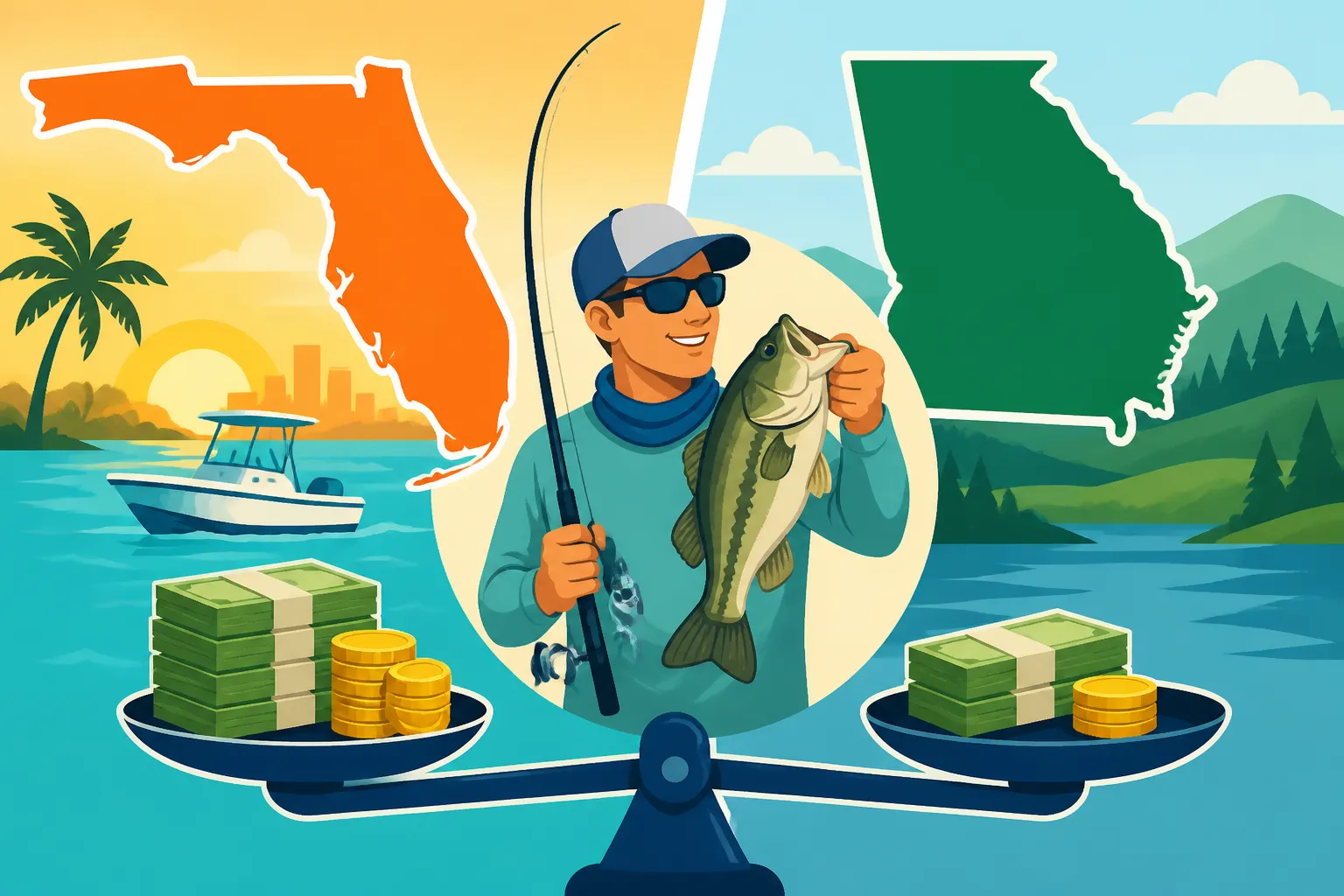
Comparing these, a Georgia resident gets a combined freshwater and saltwater license for less than what a Florida resident pays for either a single freshwater or saltwater license. Even if you add the trout stamp, the total for Georgia ($25.00) is still less than Florida's combination license ($32.50). This makes Georgia's resident annual fishing more budget-friendly on a basic, combined level.
Here's a quick comparison table:
| License Type | Florida Resident (Approx. Cost) | Georgia Resident (Approx. Cost) | Notes |
|---|---|---|---|
| Annual Freshwater | $17.00 | N/A (Included in Basic) | |
| Annual Saltwater | $17.00 | N/A (Included in Basic) | |
| Annual Combination F/S | $32.50 | $15.00 (Basic Fishing) | Georgia's basic license covers both, Florida's combo is a separate purchase. |
| Annual Fishing + Trout | N/A | $25.00 ($15 F/S + $10 Trout) | Florida's licenses don't typically have separate "trout" endorsements like Georgia. |
| 5-Year Combination F/S | $159.50 | N/A | Florida offers long-term options for residents. |
Non-Resident Annual License Costs Side-by-Side
For non-residents, the prices naturally jump up in both states.
Florida Non-Resident Annual Options:
- Freshwater: Around $47.00
- Saltwater: Around $47.00
- Combination Freshwater/Saltwater: Around $82.50
Again, a Florida non-resident must decide if they need one type of water or both. If they want to fish both all year, the combination license is their best bet.
Georgia Non-Resident Annual Options:
- Basic Fishing License (includes fresh and saltwater): Around $50.00
- Trout Stamp (if needed): Around $20.00 (additional)
In this scenario, a Georgia non-resident's basic fishing license is slightly more than Florida's individual freshwater or saltwater license, but remember it covers both. If a non-resident in Florida wanted to fish both types of water for a year, they'd pay $82.50. In Georgia, they'd pay $50.00 (or $70.00 with a trout stamp). This suggests that for a non-resident wanting to fish both freshwater and saltwater for a full year, Georgia might be the more economical choice.
Short-Term License Considerations for Tourists/Visitors
This is a critical area for anyone planning a short fishing trip.
Florida Non-Resident Short-Term Options:
- 3-Day Freshwater: Around $17.00
- 7-Day Freshwater: Around $30.00
- 3-Day Saltwater: Around $17.00
- 7-Day Saltwater: Around $30.00
- No short-term combination license is available. So, a non-resident visiting Florida for a week to fish both types of water would need two 7-day licenses, totaling $60.00.
Georgia Non-Resident Short-Term Options:
- One-Day Fishing License (includes fresh and saltwater): Around $10.00
- Trout Stamp (if needed): Around $20.00 (additional, but you can add it to the 1-day license)
For a single day of combined fishing, Georgia's $10.00 option is more straightforward and cheaper than trying to piece together short-term licenses in Florida. If you're staying for a week, Georgia's annual license at $50.00 might even be more competitive than Florida's $60.00 (for two 7-day licenses) if you plan on fishing most days.
This detailed comparison highlights that while Florida offers incredibly diverse fishing, its split licensing system can lead to higher cumulative costs, especially for non-residents wanting to fish both freshwater and saltwater for shorter durations. Georgia's combined basic license often presents a simpler, potentially more cost-effective solution for multi-species or multi-environment fishing. Always remember to check the current prices on the official state wildlife agency websites before making your purchase, as costs can change. You can usually find information on How to Buy a Fishing License Online for both states through their respective Fish and Wildlife/DNR websites.
Factors Influencing Your License Choice (and Cost!)
Choosing the right fishing license isn't just about comparing the sticker price. Several factors play a huge role in determining what you actually need and how much you'll end up spending. Overlooking these details can lead to fines, or worse, missing out on prime fishing time because you have the wrong permit.
Residency Requirements and Proof
The most significant factor affecting the cost of your fishing license in both Florida and Georgia is your residency status. As we've seen, residents enjoy substantially lower fees because they contribute to the state's conservation efforts through other taxes.
- Florida's Residency Rules: To qualify for a resident license in Florida, you must have established a permanent home in the state for at least six continuous months, immediately preceding your application. You'll typically need to provide proof like a Florida driver's license (issued at least six months prior), a Florida ID card, voter registration, or a declaration of domicile. College students might have specific rules, and new residents sometimes find it a little tricky to prove that six-month window right away. It's not enough to just own property here; you truly need to live here. Don't try to bend the rules; wildlife officers are very good at determining residency, and the penalties for fishing with an invalid resident license can be stiff.
- Georgia's Residency Rules: Georgia's requirements are similar, typically requiring at least three consecutive months of residency. Acceptable proofs often include a Georgia driver's license, a Georgia state ID card, or other official documents demonstrating a permanent address. Just like Florida, these rules are in place to differentiate between those who are truly residents and those who are temporary visitors or part-time residents.
Always ensure you meet the specific residency criteria before purchasing a resident license. If in doubt, assume you are a non-resident to avoid legal issues.
Fishing Habits and Frequency
Your personal fishing habits play a crucial role in deciding which license duration and type make the most sense for your wallet and convenience.
- Occasional Angler/Tourist: If you're only planning one or two short fishing trips a year, perhaps as part of a family vacation, a short-term license (like Florida's 3-day or 7-day options, or Georgia's 1-day) is probably your best bet. Even if it seems slightly more expensive per day than an annual license, it will save you money compared to buying a full year's worth of coverage you won't use. Remember the nuance in Florida about needing separate freshwater and saltwater short-term licenses.
- Frequent Angler/Seasonal Visitor: For those who might visit Florida or Georgia multiple times a year, or spend several weeks or months fishing, an annual non-resident license might quickly become the more cost-effective solution. If you're a "snowbird" visiting Florida for several months, for example, a Florida non-resident annual combination license might be cheaper than buying several sets of 3-day or 7-day licenses throughout your stay.
- Dedicated Local Angler: If you're a resident who fishes regularly, an annual or multi-year license is almost always the best value. Florida's 5-year resident licenses are a prime example of this, offering long-term savings and convenience.
Consider how often you realistically expect to fish and in what types of water. Don't overbuy, but also don't underbuy and find yourself needing to purchase multiple short-term licenses that add up to more than an annual. This is also where understanding Who Needs a Fishing License in Florida becomes essential, as some specific scenarios might offer exemptions.
Special Permits and Exemptions
Both states have certain exemptions and special permits that can affect your overall cost or require additional purchases.
- Exemptions:
- Age: Both states have age exemptions. In Florida, for instance, residents under 16 or over 65 (with proper certification) often don't need a recreational fishing license. Georgia also has age-based exemptions for youth and seniors. Knowing the Florida Fishing License Age Requirements is critical for families.
- Shoreline Fishing: Florida residents can sometimes fish from the shoreline of Florida without a saltwater license under specific conditions, though this typically doesn't apply to non-residents.
- Charter Boats: When fishing from a licensed charter boat in Florida, a recreational license might not be required for individual anglers, as the boat itself carries a vessel-wide license. This is a big perk for tourists!
- Free Fishing Days: Both states offer a few "free fishing days" each year where residents and non-residents can fish without a license. These are fantastic opportunities to try fishing or introduce someone new to the sport.
- Special Permits/Stamps:
- Florida: While Florida's general licenses cover most species, specific highly regulated species sometimes require an additional permit. For example, if you plan to target Snook, you'll need a Florida Snook Permit Requirements on top of your saltwater license. Similarly, for lobster, there's a Florida Lobster Permit Requirements. These are separate endorsements to your main license.
- Georgia: As mentioned, if you're fishing in Georgia's designated trout waters, you'll need an additional trout stamp. This is a specific permit to fund the state's trout stocking and management programs.
Always check for these special circumstances. A quick search on the Florida Fish and Wildlife Conservation Commission (FWC) or Georgia Department of Natural Resources (DNR) websites can provide all the up-to-date details. Ignoring these small print items could lead to a less-than-ideal encounter with a wildlife officer out on the water. Make sure you're fully covered before you cast your line.
Disclaimer
Please note that fishing license costs, rules, and regulations are subject to change by the Florida Fish and Wildlife Conservation Commission (FWC) and the Georgia Department of Natural Resources (DNR). This article provides general information and approximate costs based on data available at the time of writing. Always verify the most current and specific requirements and fees directly with the official state wildlife agencies before purchasing any license or engaging in fishing activities.