Difference Between Speckled Trout and Weakfish
It's incredibly common for even seasoned anglers to encounter a fish on the line and wonder exactly what species they've just caught, especially when two fish look so similar. The waters of Florida teem with a diverse range of marine life, and distinguishing between species like the Spotted Seatrout (often just called "speckled trout" or "specs") and the Weakfish can be a real head-scratcher. This comprehensive guide is here to untangle that confusion, giving you the clear identification markers you need to confidently tell these two beautiful fish apart.
The Identity Crisis: Why Anglers Confuse Speckled Trout and Weakfish
Let's be honest, standing on a dock or a boat deck, reeling in a fish that's flopping around, often covered in slime and sand, isn't the ideal scenario for a detailed biological examination. Both speckled trout and weakfish share a general body shape and silvery-iridescent sheen that can make initial identification tricky, particularly for those new to coastal fishing or visiting Florida from other regions.
Initial Similarities and Habitat Overlap
One of the primary reasons for confusion stems from their overlapping habitats and similar preferences. Both species are members of the drum family (Sciaenidae), which means they share certain characteristics. They both favor similar inshore environments – think seagrass flats, sandy bottoms, oyster beds, and around structure like docks and bridges. You might catch either one while targeting "trout" on a calm morning, casting artificial lures or live bait. They occupy similar niches in the food chain, often feeding on shrimp, baitfish, and small crabs. This ecological overlap means they can literally be found in the same waters, sometimes even schooling together or inhabiting adjacent territories. When you're out there, focused on the bite, it's easy to assume any silvery, spotted fish is a "speck."
Common Misconceptions on the Water
Many anglers, through no fault of their own, grow up learning general terms for fish, and "trout" can be a catch-all for a few different species, especially in a state like Florida where true freshwater trout are rare. The term "weakfish" itself hints at a misconception, as it refers to the fish's tender mouth, which can tear easily, making it challenging to land. It doesn't imply it's a "weak" fighter, which it certainly can be.
Another misconception is that any fish with spots is a "speckled trout." While spotted seatrout certainly live up to their name with prominent dark spots, weakfish can also have subtle, dusky spots or wavy lines, especially along their back, which can look similar in low light or murky water. For someone just learning the ropes, picking up a basic fishing guide or checking out some identification charts on Amazon before a trip can really help clear up these initial confusions. It’s all about knowing what specific details to look for.
Key Physical Distinctions: A Side-by-Side Look
When you get a fish in hand, there are several distinct physical characteristics that will help you definitively identify whether you've landed a spotted seatrout or a weakfish. These aren't subtle differences; once you know what to look for, it becomes second nature.
Spotting the "Speckles" and Tail Shape
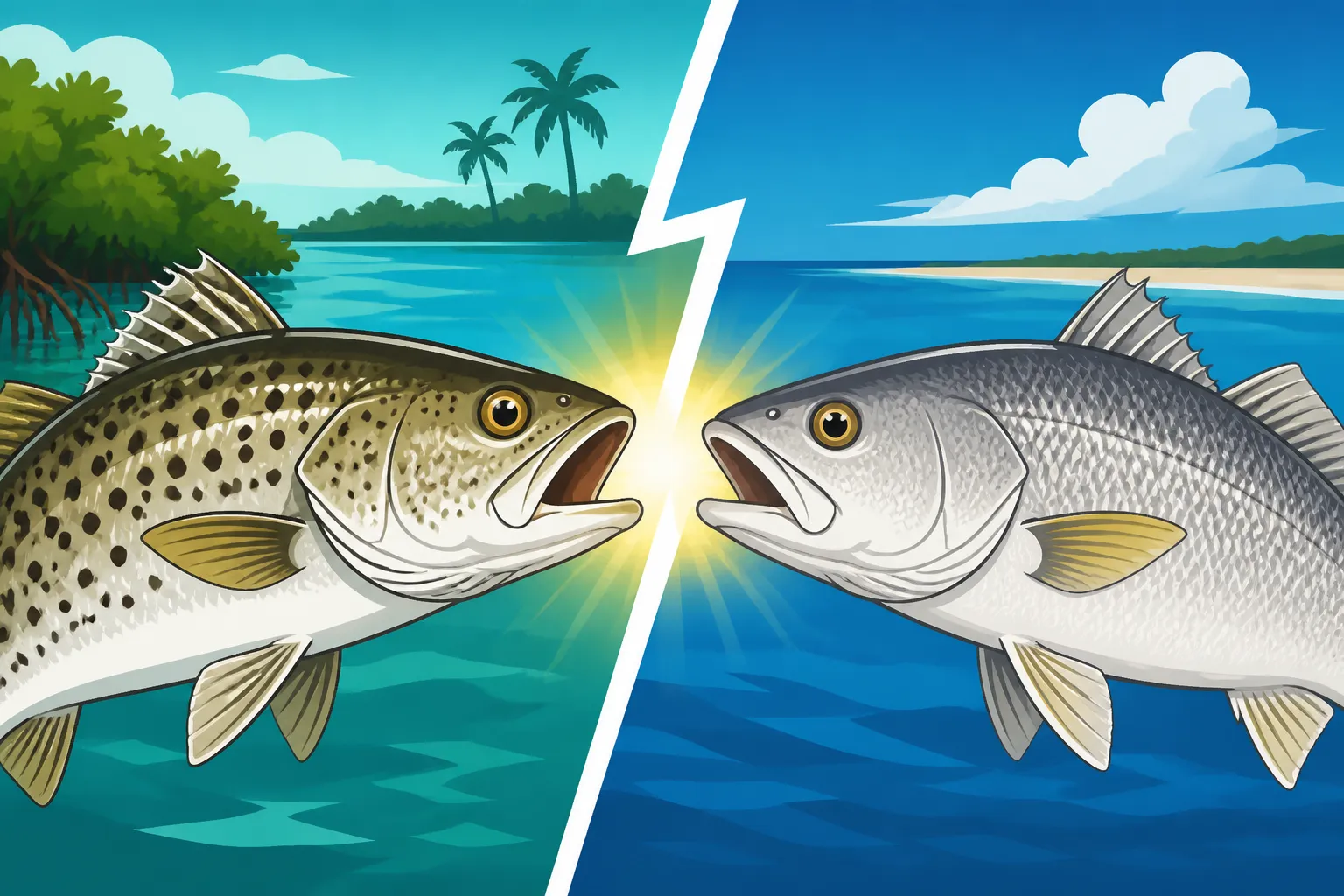
Let's start with the most obvious identifier for the spotted seatrout: its spots. As its name suggests, the spotted seatrout ( Cynoscion nebulosus) is covered in distinct, irregular, and often numerous black spots that extend not just across its back and sides, but also onto its dorsal and caudal (tail) fins. These spots are usually quite prominent and well-defined, looking almost like someone flicked black paint onto a silvery canvas.
Now, consider the tail shape. The spotted seatrout has a noticeably forked tail. This means the caudal fin has a distinct V-shape, with two lobes. This tail shape is ideal for quick bursts of speed to ambush prey in shallow water.
In contrast, the weakfish (Cynoscion regalis) typically has far fewer, if any, distinct black spots on its body. While it might have some dusky, wavy lines or very faint spots along its back and upper sides, they are nowhere near as numerous or pronounced as those on a spotted seatrout, and never extend onto the fins. Its fins are generally clear or slightly yellowish. The weakfish's tail shape is also different; it's typically truncate or slightly emarginate, meaning it's either straight across or only very slightly indented, giving it a squarer appearance than the seatrout's deeply forked tail. Imagine a subtle curve rather than a sharp V.
Jawline and Teeth: A Closer Examination
This is where things get really interesting, and it's a surefire way to tell them apart. Both fish are predators, but their mouths reveal different specializations.
The spotted seatrout has a distinctive mouth. If you gently open its mouth, you'll immediately notice two prominent, canine-like teeth located at the very front of its upper jaw. These are often referred to as "fangs" or "vampire teeth" by anglers and are perfectly designed for grasping slippery baitfish. The rest of its teeth are smaller, but those two large canines are unmistakable.
The weakfish, on the other hand, also has a set of impressive teeth, but they are arranged differently. While it has sharp, pointed teeth along its jaw, it does not possess the two enlarged, canine-like teeth at the front of the upper jaw that are characteristic of the spotted seatrout. Instead, its teeth are generally more uniform in size, though still very sharp. Think of a row of small, needle-sharp teeth rather than two prominent fangs. Always be cautious when handling either fish, as their teeth are plenty sharp enough to cause a nasty cut! Having a good pair of pliers or a dehooking tool, readily available on Amazon, is always a smart idea for both safety and fish conservation.
Body Coloration and Proportions
While both fish have a generally silvery, iridescent appearance, there are subtle differences in their overall coloration and body proportions that can help with identification.
The spotted seatrout typically has a dark, grayish-green back that fades into silvery sides, often with a yellowish tint on the belly. The iridescence can show hints of purple, blue, or gold, especially when freshly caught. Their body is generally long and slender, tapering towards the tail.
Weakfish tend to have a more vibrant, almost rainbow-like iridescence, particularly along their upper flanks. Their back is typically bluish-green or greenish-bronze, fading to silvery sides and a white or yellowish belly. They can display shimmering hues of pink, purple, and green. Their body shape is also generally more compressed laterally (taller from back to belly when viewed from the side) compared to the more cylindrical seatrout, though this can be subtle. The weakfish often appears a bit more "chunky" or deep-bodied relative to its length than the slender seatrout.
Here's a quick comparison table to help visualize these differences:
| Feature | Spotted Seatrout (Speckled Trout) | Weakfish |
|---|---|---|
| Spots | Numerous, distinct black spots on body and fins | Few to no distinct spots; faint wavy lines possible |
| Tail Shape | Distinctly forked (V-shaped) | Truncate or slightly emarginate (straighter, squarer) |
| Upper Jaw Teeth | Two prominent, canine-like "fangs" at front | No enlarged canine-like teeth; uniform sharp teeth |
| Body Color | Gray-green back, silvery sides, yellowish belly | Bluish-green/bronze back, silvery sides, vibrant iridescence |
| Body Shape | More slender, cylindrical | Slightly deeper-bodied, more laterally compressed |
| Common Size | Often caught 15-25 inches | Can grow larger, often 20-30 inches |
Habitat, Behavior, and Angling Differences
Beyond physical characteristics, understanding where and how these fish prefer to live and feed can also offer clues to their identity. While there's overlap, there are nuances that experienced anglers pick up on.
Preferred Environments and Feeding Habits
Spotted seatrout are masters of the shallow, inshore flats and estuaries. They love seagrass beds where they can ambush shrimp and small baitfish like pilchards and mullet. They often hang around oyster bars, mangrove edges, and shallow channels, especially when tides are moving. You'll find them active in relatively clear to slightly turbid water. Their feeding tends to be aggressive, often striking lures with a solid thump. They are frequently targeted with artificials like soft plastic jigs, topwater plugs, and suspending twitchbaits. Florida Spotted Seatrout Fishing Guide offers more in-depth information on targeting these popular fish.
Weakfish, while also found in estuaries, tend to prefer slightly deeper channels, inlets, and nearshore coastal waters. They are more tolerant of cooler water than speckled trout and often have a more northern distribution, though their range extends down to Florida, particularly during cooler months. They are often associated with sandy or muddy bottoms and structure like wrecks and reefs, not just grass flats. Weakfish are also opportunistic predators, eating a diet similar to trout, but they might consume more squid and crabs depending on their specific location. They tend to feed in schools, often moving with the tides.
Angling Techniques and Gear Considerations
Because of their differing preferences, the techniques used to catch them can vary, though there's certainly overlap.
For spotted seatrout, light tackle is the name of the game. A sensitive 7-foot medium-light to medium action spinning rod paired with a 2500-sized reel spooled with 10-15 lb braided line and a fluorocarbon leader is a common setup. Anglers often fish soft plastics on jig heads, popping corks with live shrimp, or small MirrOlure and D.O.A. lures. Targeting them often involves drifting flats, wading, or sight-fishing along mangrove lines. Consistency is key when fishing for speckled trout, and finding the right retrieve for your lure can make all the difference.
Weakfish, due to their slightly larger average size and preference for deeper water, might sometimes require a bit heavier tackle, though light tackle is still effective. A slightly longer rod (7'6" to 8') with a bit more backbone can be beneficial, especially if you're fishing areas with current or needing to cast further. They respond well to bottom rigs with live bait (shrimp, squid, small baitfish), bucktail jigs, and soft plastics bounced along the bottom. Often, weakfish are caught incidentally by anglers targeting other bottom-dwelling species like flounder or even redfish. The "weak" part of their name comes from their soft mouth, so a gentle hand during the fight and when dehooking is crucial to avoid tearing out the hook. This is where a reliable pair of long-nose pliers, which you can easily find on Amazon, becomes invaluable for quick and safe releases.
Seasonal Movements and Spawning
Both species exhibit seasonal movements, influenced by water temperature and spawning cycles. Spotted seatrout in Florida tend to move into shallower, warmer waters during the spring and fall, and deeper channels or nearshore areas during the extreme heat of summer or cold snaps in winter. Their spawning can occur multiple times throughout warmer months in estuaries. Best Time of Year to Fish in Florida offers a broader look at seasonal patterns for various species.
Weakfish also move in response to temperature. In Florida, they are more common during the cooler months, often migrating south from more northern waters during winter. They spawn in the spring and early summer, typically in more open coastal waters or larger estuarine systems. Understanding these general patterns can help you anticipate which species you're more likely to encounter at a given time of year or location.
Regulatory Differences and Conservation
Beyond the thrill of identification, knowing your catch is vital for adhering to fishing regulations. Florida has specific rules for spotted seatrout, and misidentifying a weakfish as a seatrout could lead to unintended violations.
Florida Specific Regulations for Spotted Seatrout
In Florida, the spotted seatrout is a highly prized recreational species, and as such, it's subject to strict management to ensure healthy populations. The Florida Fish and Wildlife Conservation Commission (FWC) sets specific regulations concerning bag limits, slot limits, and sometimes even seasonal closures. These rules can vary by region (e.g., Northwest, Northeast, Central East, South) and are subject to change. For instance, there are often minimum and maximum size limits (a "slot limit") to protect both juvenile fish and large, spawning adults. The bag limit restricts how many you can keep per person per day. It's imperative to consult the current FWC regulations before heading out, as they are regularly updated. You can find more detailed information on topics like Florida Spotted Seatrout Size and Bag Limits or Florida Fishing Regulations and Bag Limits.
Weakfish Status and Management
While weakfish are present in Florida waters, they are not as heavily targeted or managed with specific, standalone regulations as spotted seatrout are within Florida. Their populations are generally managed at a broader regional or federal level, especially further north along the Atlantic coast where they are more prevalent. Because they are not a primary target species for most recreational anglers in Florida, they might fall under general saltwater recreational bag limits for unlisted species, or there might be no specific limits. However, it’s still good practice to know if any general rules apply.
It's crucial to understand that responsible fishing means respecting all regulations, regardless of the species. Catching and releasing any fish you don't intend to keep, or that doesn't meet the legal requirements, is a cornerstone of conservation. Proper handling, minimizing time out of water, and using dehooking tools are all part of ensuring these fish can thrive for future generations.
In summary, while spotted seatrout and weakfish might give you a moment's pause with their initial similarities, a closer look at their spots, tail shape, and most importantly, their teeth, will quickly tell you which one you've got. Knowing these distinctions not only makes you a more knowledgeable angler but also helps you comply with regulations and contribute to the conservation of Florida's incredible fishery. Happy fishing!
Disclaimer
This article is for general informational purposes only and does not constitute professional advice. Laws, prices and regulations vary by location and change over time. Consult a qualified professional for guidance on your specific situation.