Difference Between Largemouth Bass and Peacock Bass
It's completely understandable why so many anglers, whether you're a seasoned local or just visiting our beautiful state, can get a little mixed up when it comes to telling a largemouth bass from a peacock bass. While both are incredible fighting fish that call Florida home, they are distinctly different species with unique characteristics and preferred habitats. This guide will help you easily distinguish between these two exciting sport fish, making your next fishing adventure in the Sunshine State a little clearer.
Key Physical Characteristics: Telling Them Apart Visually
One of the quickest ways to identify whether you've hooked a largemouth or a peacock bass is by their physical appearance. They might both be "bass," but that's where many of the similarities end. You'll notice pretty significant differences in coloration, body shape, and even fin structure once you know what to look for.
Coloration and Markings
The most striking difference often lies in their vibrant colors and distinctive patterns. Largemouth bass tend to be more subdued, while peacock bass are like living jewels.
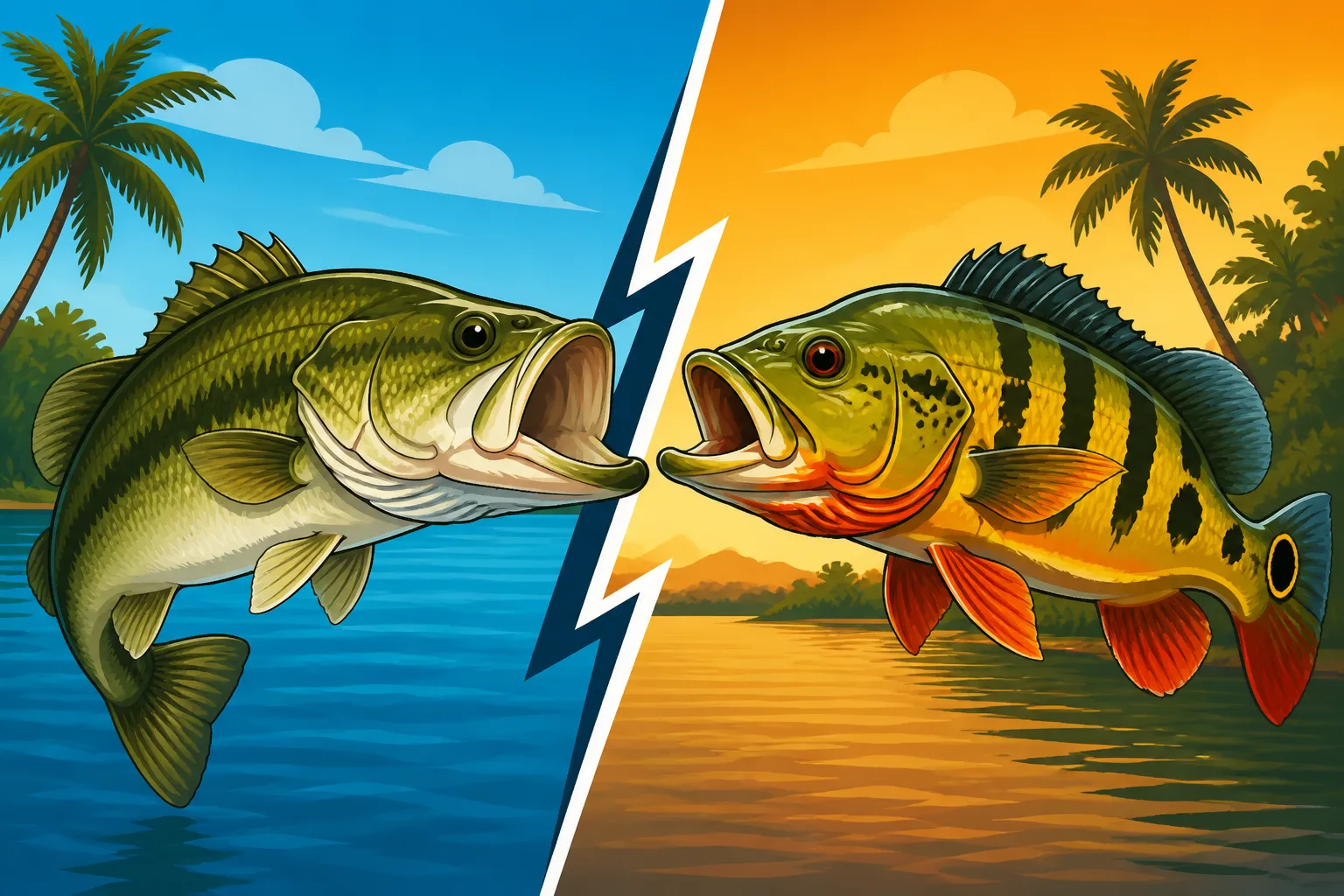
Largemouth bass, especially those found in the tannic waters of our Florida lakes and rivers, typically have a greenish back that fades into lighter green or yellowish-white sides, often with a prominent, irregular black or dark lateral stripe running from their gill plate to their tail. This stripe can sometimes appear as a series of blotches rather than a solid line, depending on the individual fish and its environment. Their bellies are usually white or cream-colored. You might notice some darker mottling or speckling on their flanks, particularly in clearer water, which helps them camouflage perfectly among submerged vegetation and structure. They are built for ambush, and their coloration reflects that.
Peacock bass, on the other hand, are an explosion of tropical color, truly earning their name from the iridescent "eyespot" (ocellus) found at the base of their tail fin, reminiscent of a peacock's feather. These fish boast brilliant gold, yellow, and orange hues, often with three distinct black vertical bars or stripes running down their sides. These bars are usually much more pronounced and consistent than the irregular stripe on a largemouth. Their fins can also show splashes of orange or red. It’s hard to mistake a peacock bass for anything else once you've seen one in person; they genuinely stand out in the clear canal waters where they thrive. The vibrant colors are a dead giveaway that you've got a Cichla species on the line.
Body Shape and Size
Beyond color, their overall body shape and typical size ranges also offer strong clues for identification. While both can grow quite large, their proportions differ.
Largemouth bass have a classic elongated, somewhat football-shaped body that is typical of many temperate bass species. They are deep-bodied and laterally compressed, meaning they're somewhat flat from side to side. Their lower jaw extends notably beyond their upper jaw, giving them that characteristic "bucketmouth" appearance, perfect for swallowing large baitfish or frogs whole. In Florida, largemouth bass are known to grow to impressive sizes, with trophy fish weighing well into the double digits. Their broad tail fin provides powerful propulsion for their explosive strikes.
Peacock bass, particularly the speckled peacock bass (Cichla temensis) which is the largest species and primarily stocked in South Florida, tend to be more robust and somewhat more streamlined than largemouth bass. They have a more pointed head and a less exaggerated "bucketmouth," though their mouths are still quite large and capable of engulfing sizable prey. Their bodies are deep, but perhaps not quite as laterally compressed as a largemouth. While Florida's introduced peacock bass don't typically reach the behemoth sizes of their Amazonian relatives, they still provide an incredible fight and can reach respectable weights. Their body shape is adapted for swift, aggressive pursuit rather than pure ambush.
Native vs. Introduced: Understanding Their Origins in Florida
Knowing the history of these two species in Florida is crucial not just for identification, but also for understanding their distribution and the ecosystems they inhabit. One is a true native, woven into the fabric of our state's freshwater systems, while the other is a welcome, yet introduced, guest.
Largemouth Bass: Florida's Freshwater Icon
The largemouth bass (Micropterus salmoides) is the undisputed king of Florida's freshwater fishing scene and is a native species. It has been thriving in our lakes, rivers, and ponds for millennia, evolving to become the robust and powerful fish we know today. Florida is particularly famous for its unique strain of largemouth, often called the "Florida Strain," which is renowned for its potential to grow exceptionally large, even in warmer waters. This native status means they are perfectly adapted to the varied freshwater environments across the entire state.
You'll find largemouth bass in virtually every freshwater body in Florida, from the expansive waters of Lake Okeechobee Fishing Guide to the intricate networks of the St. Johns River. They are masters of their domain, perfectly at home in everything from clear spring-fed lakes to murky, tannin-stained swamps. This widespread distribution is a testament to their adaptability and their long history as a cornerstone of Florida's freshwater ecosystems. When you're fishing for largemouth here, you're tapping into a tradition that goes back generations.
Peacock Bass: The South Florida Transplant
Peacock bass (primarily the speckled peacock bass, Cichla temensis, and occasionally the butterfly peacock bass, Cichla ocellaris) are not native to Florida. They were intentionally introduced by the Florida Fish and Wildlife Conservation Commission (FWC) in the mid-1980s into the intricate canal systems of South Florida. The main purpose of this introduction was to help control populations of unwanted exotic cichlids, such as the Mayan cichlid, which were overpopulating and potentially harming native fish communities. They were also introduced to provide a new and exciting sport fishery for anglers.
Because they are a tropical species, peacock bass are extremely sensitive to cold temperatures. This is why their distribution in Florida is strictly limited to the warmer waters of extreme South Florida, mainly within Broward and Miami-Dade counties, and extending slightly into Palm Beach County. You won't find them naturally thriving north of these areas. These fish absolutely need water temperatures that rarely dip below the mid-60s Fahrenheit to survive, let alone reproduce. The extensive man-made canal systems in these urban and suburban areas provide the perfect warm-water habitat for them, making places like Miami's canal network the prime spot for targeting these colorful fighters. If you're fishing anywhere else in the state, you can be pretty sure that aggressive bass on your line is a largemouth.
Habitat and Behavior: Where and How They Live
Beyond their looks and origins, understanding where each species lives and how they behave can greatly improve your chances of catching them, and also help solidify your identification skills. They have distinct preferences that shape their daily lives.
Preferred Environments and Structures
Both species are predatory fish, but they seek out different types of environments and utilize structures in unique ways. This is largely tied back to their native ranges and tolerance for cold.
Largemouth bass are incredibly versatile and can be found in a vast array of freshwater habitats across Florida. They love areas with plenty of cover and structure where they can ambush prey. This includes submerged vegetation like hydrilla, lily pads, and cattails, as well as fallen trees, brush piles, docks, and rocky ledges. They are just as comfortable in the wide-open expanse of a large lake as they are tucked away in a quiet backwater creek. Water clarity can vary wildly, from crystal-clear spring-fed rivers to stained, tannic swamps. Their ability to adapt to so many different freshwater environments is a key reason for their widespread success and why they are such a beloved target for anglers throughout the state. Best Freshwater Fishing Lakes in Florida are teeming with them.
Peacock bass, as mentioned, are confined to the warm, interconnected canal systems of South Florida. These canals are often urbanized, flowing through residential areas, golf courses, and alongside busy roads. While they do utilize structure, it's typically man-made or emergent vegetation found along canal banks. Look for them around culverts, bridges, seawalls, fallen trees, rock piles, and especially canal intersections or spillways where current creates eddies. They prefer clearer water than largemouth bass, which is characteristic of many of the South Florida canals. Because their habitat is so specific, if you're pulling a colorful, barred bass out of a canal in Miami, it's almost certainly a peacock bass. They rarely venture into truly brackish water, unlike some largemouth.
Hunting Strategies and Diet
Their distinct body shapes and habitats also dictate their hunting styles and what they primarily prey upon. Both are voracious predators, but they have their preferred menus and methods.
Largemouth bass are classic ambush predators. They will lie in wait, perfectly camouflaged within dense cover, ready to explode on unsuspecting prey that swims too close. Their wide, bucket-like mouth is designed to inhale prey with incredible speed. Their diet is incredibly varied, reflecting the diverse ecosystems they inhabit. They'll eat anything from baitfish like shiners, shad, and bluegill to frogs, crawfish, snakes, small birds, and even baby alligators! This opportunistic feeding strategy means they'll often strike at a wide range of artificial lures and live baits. Understanding their ambush tactics is key to successful Florida Bass Fishing Techniques.
Peacock bass are more active, aggressive hunters, often chasing down their prey in open water or along structure rather than solely relying on ambush. They are known for their powerful strikes and sustained fights. Their primary diet consists almost exclusively of smaller fish, especially the abundant exotic cichlids that also thrive in the South Florida canals. This makes them an excellent biological control agent. While they can be tempted by artificial lures that mimic baitfish, they are notoriously aggressive towards live shiners or other small minnows. Their relentless pursuit and tendency to strike multiple times make them an exhilarating catch for any angler. Many anglers find specific lures that mimic tilapia or shiners on Amazon to be particularly effective.
Fishing Techniques and Gear Considerations
Since these two fish inhabit different environments and have slightly varied behaviors, the techniques and gear you might use to target them also show some distinctions. While there's certainly overlap, fine-tuning your approach can make a world of difference.
Tackle and Lure Preferences
Choosing the right rod, reel, and bait can enhance your success for both species. While many bass techniques work for both, some specifics can improve your odds.
For largemouth bass, you'll find anglers using a huge variety of tackle setups, from heavy baitcasting gear for punching through thick mats of hydrilla to lighter spinning outfits for finesse presentations. Rods typically range from medium-heavy to heavy power with fast actions, paired with baitcasting or spinning reels spooled with monofilament, fluorocarbon, or braided line. When it comes to lures, the sky's the limit! Plastic worms, spinnerbaits, crankbaits, jerkbaits, jigs, and topwater lures are all highly effective. Live baits like shiners are also perennial favorites. The key is often matching the hatch or presenting something irresistible in their ambush zones. You can explore a huge selection of options, from budget-friendly plastics to high-end hard baits, all available through retailers like Amazon.
Peacock bass often respond well to lighter to medium-heavy spinning or baitcasting setups, generally favoring lures that mimic small baitfish. Topwater lures like prop baits and poppers are incredibly exciting when targeting peacocks, as they produce explosive strikes. Small to medium-sized jerkbaits, lipless crankbaits, and swimbaits are also highly effective. Live shiners or small golden tilapia are absolute peacock bass candy, often leading to a frantic feeding frenzy. Because peacocks fight so hard, having a reel with a smooth drag system and a rod with a good backbone is important. Many anglers specifically search for these types of specialized lures and tackle on platforms like Amazon, especially for the unique fishing scenarios presented by the South Florida canals.
Locating and Targeting Strategies
The search for these fish will take you to different corners of Florida and require different scouting methods.
When targeting largemouth bass, you'll likely be exploring vast lakes, winding rivers, or secluded ponds. Look for visible structure such as lily pads, reeds, fallen trees, or boat docks. Submerged structure, which can be found using sonar, is also key. Focusing on points, creek channels, and changes in bottom contour can be highly productive. Early mornings and late evenings are often prime times, especially during warmer months, as bass move into shallower water to feed. During colder periods or hot afternoons, they might retreat to deeper water or denser cover. Best Time of Year to Fish in Florida will give you seasonal insights for targeting them effectively.
For peacock bass, your search will be concentrated in the extensive freshwater canal systems of South Florida. These canals are often easily accessible from shore, bridges, or by small boats and kayaks. Focus your efforts around any kind of structure that breaks the current or provides cover: bridge pilings, culverts, seawalls, intersections of canals, and areas with submerged rocks or ledges. Peacock bass are very aggressive and will often hold in specific spots, waiting for prey to come by. They are less temperature-tolerant than largemouth, so consistently warm weather is best. A great strategy is to work your way along canal banks, casting towards any visible structure or current breaks. Don't be surprised if they hit your lure aggressively right at your feet or when sight fishing in clear water.
| Feature | Largemouth Bass | Peacock Bass |
|---|---|---|
| Origin in Florida | Native | Introduced (South Florida only) |
| Coloration | Greenish back, lighter sides, dark lateral stripe | Vibrant gold/yellow, 3 dark vertical bars, "eyespot" on tail |
| Body Shape | Elongated, deep-bodied, prominent "bucketmouth" | Robust, streamlined, less exaggerated mouth |
| Primary Habitat | Widespread freshwater lakes, rivers, ponds | South Florida urban/suburban canals (warm water only) |
| Hunting Style | Ambush predator (cover-oriented) | Active, aggressive hunter (chases prey) |
| Primary Diet | Fish, frogs, crawfish, various small animals | Primarily exotic cichlids and other small fish |
| Cold Tolerance | High (can tolerate wide range of temps) | Low (requires consistently warm water) |
| Typical Range | Found throughout Florida | Limited to Broward, Miami-Dade, Palm Beach counties |
Knowing the distinct differences between Florida's native largemouth bass and the introduced peacock bass not only helps you identify your catch but also refines your fishing strategies. Whether you're chasing the green giants of Lake Okeechobee or the colorful fighters of Miami's canals, Florida offers incredible bass fishing opportunities. Happy fishing, everyone!
Disclaimer
This article is for general informational purposes only and does not constitute professional advice. Laws, prices and regulations vary by location and change over time. Consult a qualified professional for guidance on your specific situation.