Florida Spotted Seatrout Fishing Guide
Florida's sparkling inshore waters hold a special place in many anglers' hearts, and for good reason: the spotted seatrout is a true jewel of the flats. However, consistently locating and enticing these beautiful fish can be a real challenge, especially for those new to the Sunshine State's unique ecosystems. Between understanding their habits, picking the right gear, and navigating ever-changing regulations, it's easy to feel overwhelmed. This comprehensive guide is designed to cut through the confusion, offering you everything you need to know to become a confident and successful spotted seatrout angler in Florida, whether you're targeting dinner or chasing a trophy.
Understanding the Florida Spotted Seatrout
The spotted seatrout (Cynoscion nebulosus), often affectionately called "speckled trout" or just "specks," is one of Florida's most popular inshore game fish. They're not only widely distributed and accessible but also offer a fantastic fight on light tackle and make for excellent table fare. To consistently catch them, it's essential to understand what makes them tick – from their unique appearance to their preferred dining habits.
Distinctive Features and Identification
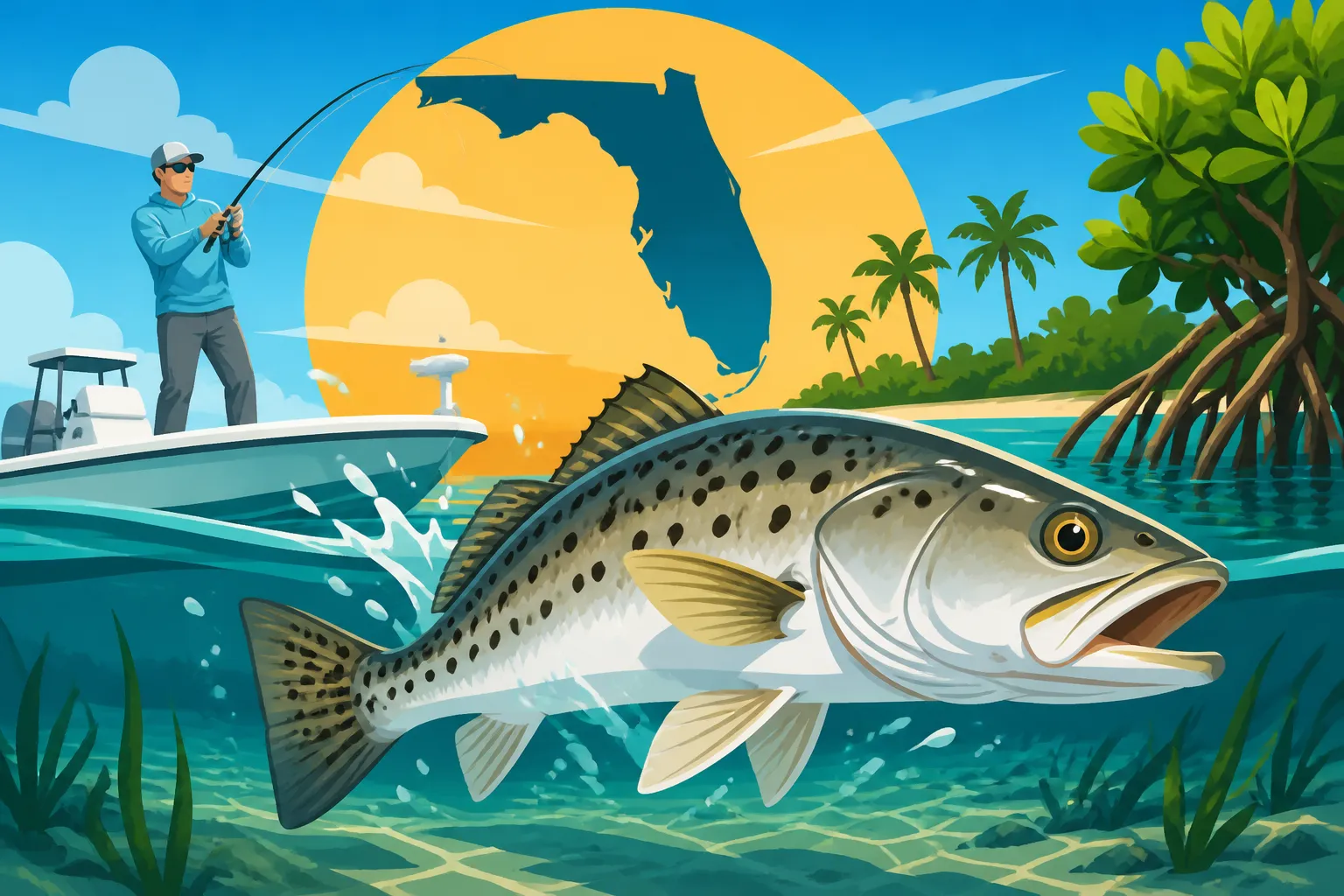
Spotted seatrout are sleek, elongated fish with an iridescent silver-gray body that transitions to a lighter, sometimes pearly white, belly. What truly sets them apart and gives them their common name are the numerous distinct black spots scattered across their back, sides, and dorsal fins. These spots are usually quite clear and defined, unlike some other species that might have more blotchy or faded markings. Their fins are typically dusky or yellowish.
One common misconception is confusing them with other trout species, but in Florida, the spotted seatrout is generally the one people refer to as "trout." They possess a somewhat soft mouth, which requires a gentle hand during the fight to avoid tearing the hook out. Their upper jaw features two prominent canine-like teeth, perfectly adapted for grabbing and holding onto their prey, while the rest of their mouth is lined with smaller, sharper teeth. Knowing these features helps with identification and also informs your choice of tackle and leader material to prevent bite-offs. If you're ever in doubt, understanding the Difference Between Speckled Trout and White Trout can clear up any confusion you might have, as they are sometimes found in similar areas.
Life Cycle and Behavior
Spotted seatrout are prolific spawners, often reproducing multiple times a year in shallow, brackish estuaries. This ability to spawn frequently in their inshore habitats is a key factor in their abundance throughout Florida. They are generally considered non-migratory within their home estuaries, meaning that if you find a good spot, there's a good chance trout will be there year-round, though their specific locations within that estuary might shift with conditions.
As opportunistic ambush predators, seatrout primarily feed during periods of moving water, particularly at dawn and dusk. They have excellent eyesight and will often lurk in areas where they can dart out to surprise unsuspecting baitfish, shrimp, or crabs. While larger, older trout tend to be more solitary, smaller to medium-sized fish frequently form schools, especially when actively feeding. This schooling behavior can lead to "hot spots" where anglers can catch multiple fish in a short amount of time once a school is located. Their preferred diet, a mix of small baitfish like pilchards, mullet, and glass minnows, along with shrimp and crabs, directly influences the types of baits and lures we use to catch them.
Preferred Habitats and Environmental Factors
Spotted seatrout thrive in the brackish and saltwater environments of Florida's extensive estuaries, sounds, and coastal waters. They have a preference for clear to slightly turbid water with healthy seagrass beds. These grass beds serve as both a hunting ground and a sanctuary, providing camouflage for the trout and attracting the baitfish they prey upon. Beyond seagrass, they also frequent oyster bars, mangrove shorelines, tidal creeks, and the edges of deeper channels.
Water temperature is a significant factor influencing their activity. They are most active in comfortable temperatures, typically ranging from the mid-60s to low 80s Fahrenheit. During colder months, especially after a strong cold front, trout tend to seek deeper pockets of water, canals, or spring-fed areas where temperatures are more stable. Conversely, during the scorching summer heat, they might move to slightly deeper water or seek shade under docks and mangroves during the hottest parts of the day. Understanding these seasonal shifts is critical; for instance, you'll find that Why Trout Move to Deeper Water in Summer dictates different strategies than Why Grass Flats Hold More Trout in Winter. Strong winds can also impact their behavior, sometimes pushing them into calmer, protected waters.
Prime Habitats and Where to Find Them
Knowing what a spotted seatrout looks like is one thing, but knowing where to look for them is the real secret to consistent success. Florida offers an incredible diversity of inshore environments, and seatrout utilize many of them throughout the year.
Seagrass Flats: The Trout's Pantry
Without a doubt, healthy seagrass flats are the quintessential spotted seatrout habitat in Florida. These underwater meadows are bustling ecosystems, providing shelter and food for a myriad of small baitfish, shrimp, and crabs – precisely what trout love to eat. The deeper, healthier grass is often the most productive. Look for areas where the grass is a vibrant green, indicating good water quality and an active ecosystem. Patches of sand within the grass, known as "potholes," are also prime ambush points.
When fishing grass flats, stealth is your best friend. Trout can be easily spooked by sudden movements or loud noises. From a boat, consider using a trolling motor on a low setting or, even better, a push pole to navigate quietly. If wading, shuffle your feet to avoid disturbing the bottom too much. Fan-casting across the flats, covering different depths and orientations to the current, is an effective strategy. Pay attention to any disturbances on the water's surface, like baitfish jumping, which could signal actively feeding trout below.
Oyster Bars and Shell Rakes
Oyster bars and shell rakes are natural structural features found throughout Florida's estuaries, and they are absolute magnets for spotted seatrout. These hard bottom areas provide excellent habitat for a variety of marine life, including small crabs and shrimp, which in turn attract baitfish. Trout will often position themselves on the edges of these bars, especially where there's a slight drop-off into deeper water, waiting for the current to deliver a meal.
Fishing around oyster bars requires a bit more care due to the sharp shells. A stronger leader material is advisable to prevent cut-offs. Focus your casts along the edges where the current flows, and also into any deeper pockets or channels that run alongside the bar. The key is to present your bait or lure in a way that mimics a wounded baitfish or shrimp being swept off the structure by the tide. These areas are particularly productive on a moving tide, as the current dislodges food and concentrates baitfish.
Docks, Piers, and Structure
While natural habitats are prime, spotted seatrout also readily congregate around man-made structures such as docks, piers, bridges, and jetties. These structures offer shade, shelter from predators, and often have lights that attract baitfish at night, making them fantastic ambush points. You'll often find a mixed bag of species here, but trout are a common catch.
When fishing docks, cast your bait or lure as close to the pilings and underneath the dock as possible. The shade provides a sense of security for trout, and they often hold tight to the structure. At night, especially during the warmer months, dock lights can create veritable feeding frenzies. The light attracts plankton, which attracts baitfish, and the baitfish attract predators like trout. This can be an incredibly productive way to fish, and mastering the Night Fishing Technique for Trout Under Dock Lights can lead to some unforgettable evenings. Remember that specific rules apply to fishing from these structures, so it's wise to check if Do You Need a License to Fish From a Florida Pier? applies to your chosen spot.
Best Baits and Lures for Spotted Seatrout
One of the beautiful things about spotted seatrout is their willingness to strike a wide variety of baits and lures. Whether you prefer the thrill of live bait or the satisfaction of fooling a fish with artificials, there's a method for you.
Live Bait: The Natural Advantage
When fish are finicky or the bite is tough, live bait is often the most reliable option for convincing a spotted seatrout to strike. Nothing quite mimics the real thing like, well, the real thing!
Live shrimp are arguably the king of live baits for trout. They're irresistible to just about any inshore predator, and trout are no exception. You can fish them under a popping cork, free-lined with a small split shot, or on a simple jig head. When rigging, hook the shrimp lightly through the horn on its head or through the tail, ensuring it stays lively. How to Rig a Live Shrimp for Trout is a crucial skill to master for maximum effectiveness.
Beyond shrimp, small baitfish like pilchards, greenbacks, or finger mullet are excellent choices, especially for targeting larger trout. Hook these baits through the nose or just behind the dorsal fin, allowing them to swim naturally. Pinfish can also be very effective, though their spiny fins can be a nuisance. You can often catch your own live bait using a cast net, which is a rewarding skill to learn. Understanding How to Cast Net for Live Bait will save you money and ensure you have the freshest bait available.
Artificial Lures: Versatility and Efficiency
For anglers who prefer the active approach of casting and retrieving, artificial lures offer incredible versatility and can be highly effective for spotted seatrout. The key is to choose lures that mimic their natural prey and present them with lifelike action.
Soft plastic jerkbaits and paddletails are incredibly popular and productive. Brands like DOA CAL and Z-Man offer a wide array of colors and sizes. These are typically rigged on a lightweight jig head (1/8 to 1/4 ounce, depending on depth and current) and retrieved with a twitch-pause action that imitates a wounded baitfish or shrimp. The subtle tail action of a paddletail retrieved slowly can be deadly. Look for colors like "new penny," "chartreuse," or "rootbeer" with gold flake. You can find a huge selection of these versatile lures on Amazon, making it easy to experiment with different options.
Topwater plugs, such as the MirrOlure Top Dog or Rapala Skitter Walk, create an exciting surface commotion that can trigger aggressive strikes, especially during low light conditions or when trout are actively feeding on baitfish near the surface. The "walk-the-dog" retrieve, a side-to-side sashay, is incredibly effective. Hard jerkbaits (like the MirrOdine) and spoons (gold or silver) can also be excellent, particularly when fishing around deeper grass or targeting larger, more aggressive trout. Don't forget to consider Best Lure Color for Murky Water in Florida if you're fishing in less-than-clear conditions.
Rigging Techniques for Success
Proper rigging is just as important as choosing the right bait or lure. A well-rigged setup ensures natural presentation, reduces tangles, and maximizes your chances of a hook-up.
The popping cork rig is a classic for live shrimp or soft plastics. It consists of a leader tied below a noisy, buoyant cork. When you twitch your rod tip, the cork creates a "pop" or "chug" sound that mimics a feeding fish, attracting trout from a distance. The cork also suspends your bait at a desired depth. This technique is incredibly effective on grass flats, and learning How to Fish a Popping Cork for Trout is a must for any seatrout angler.
A simple jig head is another fundamental rigging option. As mentioned, 1/8 to 1/4 ounce jig heads are ideal for most inshore trout fishing, allowing your soft plastic or live shrimp to sink slowly and naturally. For deeper water or stronger currents, you might go up to 3/8 ounce. When fishing around oyster bars or patchy bottom, a Carolina rig can be very effective. This rig uses an egg sinker above a swivel, with a fluorocarbon leader and hook below, allowing the bait to drift naturally near the bottom while the weight drags above it.
Essential Gear for Seatrout Anglers
Having the right equipment not only makes fishing more enjoyable but also significantly improves your success rate. Spotted seatrout are not line-shy or particularly brutal fighters, so light to medium-light tackle is usually sufficient and adds to the sporting challenge.
Rods and Reels: Matching the Task
For spotted seatrout, sensitivity is often more important than brute strength in your rod. A medium-light to medium power spinning rod, typically between 6'6" and 7'6" in length, is ideal. This length provides good casting distance for covering expansive flats, while the lighter power allows you to feel subtle bites and offers a great fight without overpowering the fish's relatively soft mouth. A fast action tip will help with detecting those soft "thumps" and setting the hook quickly.
Pair your rod with a reliable spinning reel in the 2500 to 3000 series. These reels strike a perfect balance, offering enough line capacity, a smooth drag system, and a comfortable retrieve speed without being overly heavy. Brands like Penn, Shimano, and Daiwa all offer excellent options in this size range. A smooth drag is crucial for preventing hook pulls, especially on larger trout. You want a reel that can handle repeated casting throughout the day without fatigue.
Line and Leader: Strength and Stealth
Your line and leader setup are critical for both casting performance and stealth. For your main line, 10 to 15-pound braided line is a popular choice for trout fishing. Braid offers exceptional casting distance, incredible sensitivity to detect light bites, and virtually no stretch, which helps with solid hooksets. The thinner diameter of braid at a given breaking strength also means less wind resistance when casting. While What Pound Test Line for Snook Fishing? might be higher, a slightly lighter braid works perfectly for trout.
To connect your braid to your lure or hook, a fluorocarbon leader is highly recommended. Fluorocarbon is nearly invisible underwater, which helps with stealth, and it offers excellent abrasion resistance against oyster shells, grass, and the trout's sharp teeth. A 20 to 30-pound fluorocarbon leader, about 2-3 feet long, is a good general choice. You'll want to connect your braid to your fluorocarbon leader using a strong knot like the FG knot or a double uni knot. Learning these knots will prevent break-offs and ensure you don't lose that trophy trout.
Terminal Tackle and Accessories
Beyond the rod, reel, and line, a few key terminal tackle items and accessories will round out your spotted seatrout kit. For live bait, ensure you have an assortment of appropriate hooks. Circle hooks (size 1/0 to 3/0) are excellent for conservation, as they tend to hook fish in the corner of the mouth, making release easier. If using artificials, having a good selection of jig heads in various weights (1/8 oz, 1/4 oz, 3/8 oz) is essential to match different depths and current conditions.
Don't forget split shot weights for adjusting bait depth, and small swivels if you're using a Carolina rig. Beyond the fishing end of things, a good pair of pliers (preferably saltwater-resistant) for de-hooking, cutting line, and general tasks is indispensable. A de-hooking tool, like those available on Amazon, can make releasing fish much safer for both the angler and the fish. A small, rubberized landing net is also a great asset for gently scooping up trout, minimizing stress and preventing them from thrashing on the deck or ground.
| Item | Description | Recommended Specifications |
|---|---|---|
| Rod | Spinning Rod, Medium-Light to Medium Power | 6'6" – 7'6" length, Fast Action |
| Reel | Spinning Reel | 2500 – 3000 series |
| Main Line | Braided Line | 10 – 15 lb test |
| Leader | Fluorocarbon Leader | 20 – 30 lb test, 2-3 feet long |
| Hooks | Circle Hooks (Live Bait) | 1/0 – 3/0 |
| Jig Heads | Lead or Tungsten | 1/8 oz, 1/4 oz, 3/8 oz |
| Lures | Soft Plastics (Jerkbaits, Paddletails), Topwater | Various colors/sizes, minnow imitations |
| Accessories | Pliers, De-hooker, Landing Net, Polarized Glasses | Saltwater resistant, rubberized net |
Effective Fishing Techniques and Strategies
Beyond having the right gear and knowing the habitat, employing effective techniques is what truly separates consistent anglers from occasional lucky ones. Spotted seatrout often behave predictably, and understanding their patterns in relation to tides, current, and lure presentation will significantly boost your catch rates.
Reading the Tides and Current
Inshore fishing, especially for species like spotted seatrout, is inextricably linked to tidal movement. The ebb and flow of the tide dictate when baitfish are most active and where trout will position themselves to feed. Ignoring the tides is like trying to navigate a dense fog – you might get lucky, but you're probably going to be lost.
An incoming tide often pushes cleaner, cooler water and fresh bait onto the flats and into tidal creeks. As the water rises, trout will move with it, venturing into shallower areas to ambush prey that has moved onto the grass beds. During this phase, focus your efforts on the edges of channels, points, and grass beds that are just beginning to get covered by water. Learning How to Fish an Incoming Tide is a game-changer for many inshore species.
Conversely, an outgoing tide pulls water, and often disoriented bait, off the flats and back into deeper channels and passes. Trout will often set up at pinch points, creek mouths, and channel edges, forming an ambush line for the retreating bait. Both high and low tides can be productive, but it's the movement of the water that is most critical. Many anglers wonder, Do Fish Bite Better at High Tide or Low Tide?, and the answer is often "it depends on the species and location," but for trout, active water movement is usually key.
Fan Casting and Drifting
When covering expansive grass flats or large sections of an estuary, efficient searching techniques are vital. You can't catch a fish if your bait isn't where they are, and fan casting and drifting allow you to systematically explore productive areas.
Fan casting involves making a series of casts in a wide arc, starting from one direction and working your way around to the other. This ensures you're covering as much water as possible from a stationary position (whether in a boat, wading, or on shore). Pay attention to where you get a bite; it might indicate a school of fish or a productive patch of habitat, allowing you to focus your subsequent casts in that direction.
Drifting is another highly effective method, particularly when fishing from a boat over large grass flats. By allowing your boat to drift with the wind or current, you cover a vast amount of water naturally, presenting your bait or lure to undisturbed fish as you move. Use a trolling motor to adjust your drift speed or angle if needed. If drifting over particularly sensitive areas, learning How to Anchor a Boat on a Flat Without Spooking Fish can also apply to how you maintain a quiet presence while drifting or stalking.
Lure Presentation and Retrieves
Once you've found a promising area, your lure presentation is paramount. You need to make your artificial bait look as appealing and natural as possible to entice a strike. This often means mimicking the behavior of the baitfish, shrimp, or crabs that trout naturally feed on.
For soft plastics rigged on jig heads, a common and effective retrieve involves casting out, letting the lure sink for a few seconds (depending on depth), and then imparting a series of short twitches with your rod tip, followed by a pause. The pause is crucial, as many strikes occur when the lure is falling or resting. Vary the retrieve speed and twitch intensity until you find what the fish prefer on a given day. Sometimes a slow, steady retrieve with a paddletail is all it takes; other times, an erratic, aggressive jerk-and-pause is more effective.
When using topwater lures, the "walk-the-dog" retrieve is the standard. This involves a rhythmic twitch of the rod tip while reeling in slack, causing the lure to sashay from side to side across the surface. This mimics a struggling baitfish and can provoke explosive strikes that are incredibly exciting. Experiment with the speed and length of your pauses; sometimes a longer pause is what convinces a hesitant trout to commit.
Spotted Seatrout Seasons and Regulations
Florida's abundant fisheries are carefully managed to ensure their sustainability, and spotted seatrout are no exception. Understanding the best times to target them and, crucially, adhering to the latest regulations are essential for responsible angling and continued good fishing.
Best Time of Year to Target Trout
The good news for Florida anglers is that spotted seatrout are present in the state's inshore waters year-round. However, their activity and preferred locations will change with the seasons, making certain times of the year particularly productive. Generally, spring and fall are considered the peak seasons for trout fishing. During these periods, water temperatures are ideal (typically in the mid-70s), baitfish are abundant, and trout are actively feeding across the flats and in creeks. The mild weather also makes for very comfortable fishing conditions. You'll find that Best Month to Catch Spotted Seatrout in Florida can vary slightly by region, but spring and fall are universally excellent.
In summer, trout are still very catchable, but the scorching heat often means the best fishing occurs during low-light hours – early mornings, late evenings, and even into the night, especially around dock lights or lighted bridges. During the hottest part of the day, trout might retreat to deeper grass beds, channels, or shaded areas. Winter fishing can also be fantastic, particularly after a few stable, cooler days. Trout will often congregate in deeper holes, canals, or protected backwaters where water temperatures are more consistent.
Florida Spotted Seatrout Size and Bag Limits
Florida's fish and wildlife conservation commission (FWC) implements specific regulations to protect spotted seatrout stocks, especially larger breeding females. These regulations are subject to change, so always check the latest FWC guidelines before heading out. Generally, a slot limit is in place, meaning you can only keep fish that fall within a certain length range. For example, a common slot might be 15-19 inches, with only one fish per angler allowed to be over the maximum length within that slot. The Florida Spotted Seatrout Size and Bag Limits are designed to ensure enough fish mature and reproduce.
Bag limits specify the maximum number of fish you can keep per person per day. These are often around five fish per angler, but this can also vary by region (e.g., Northwest vs. Northeast vs. Southwest Florida). It's crucial to measure your fish accurately immediately after catching them. If a fish is outside the slot, it must be released immediately and unharmed. These rules are not just bureaucratic hurdles; they are vital for maintaining healthy populations of spotted seatrout for future generations of anglers.
Conservation Efforts and Responsible Angling
The regulations set by the FWC are part of a broader conservation effort to ensure the long-term health of Florida's spotted seatrout population. As anglers, we play a significant role in these efforts. Adhering strictly to size and bag limits is the most fundamental way to contribute. Releasing oversized fish, particularly the larger "gator trout" (those over 20 inches), is also a common practice among conservation-minded anglers, as these larger fish are often vital breeding females.
Beyond simply following the rules, practicing responsible catch and release, especially for fish you don't intend to keep or those outside the legal slot, helps minimize stress and injury. Using appropriate de-hooking tools, handling fish gently with wet hands, and supporting their full body weight are all part of a good release strategy. These small actions collectively make a huge difference in protecting this beloved species.
Advanced Tips for Trophy Trout and Consistent Catches
While catching a few keeper trout for dinner is always a great day, many anglers aspire to consistently land larger, "gator" trout or simply to be more consistent in their catches. This often requires a more nuanced approach, paying attention to subtle cues and adjusting your strategy.
Targeting Larger Fish
Trophy-sized spotted seatrout, often referred to as "gator trout" when they exceed 25 inches, tend to behave differently than their smaller counterparts. They are often more solitary, less prone to schooling, and can be more wary. To target these larger fish, you often need to adapt your tactics.
One key strategy is to use larger baits and lures. While smaller trout will eagerly strike a two-inch shrimp, a gator trout is more likely to be interested in a substantial meal like a 4-6 inch live pilchard, pinfish, or mullet. Similarly, artificials like larger soft plastics, substantial topwater plugs, or even hard jerkbaits can attract the attention of a trophy fish. Concentrate your efforts on areas where larger trout are likely to hold, such as deeper grass beds, the edges of strong current breaks, and areas with significant structure where they can ambush prey. These fish didn't get big by being careless, so a stealthy approach is paramount.
Weather and Environmental Factors
Understanding how weather and environmental conditions influence trout behavior is a significant step towards consistent catches. Fish are cold-blooded creatures, and external factors directly impact their metabolism and activity levels.
Cold fronts, for instance, can dramatically affect trout fishing. A strong cold front often brings a sharp drop in air and water temperatures, making trout lethargic and causing them to seek warmer, deeper water. Fishing after a cold snap might require you to target those deeper channels, residential canals, or spring-fed areas. Fishing After a Cold Snap in Florida details specific strategies for these conditions. Conversely, stable weather patterns with consistent temperatures and light winds often lead to more predictable and active feeding.
Moon phases and tidal strength also play a role. Stronger new and full moon tides can create more intense current, which can either stimulate feeding or make trout hunker down depending on the conditions. While not always a direct correlation, many anglers find that Does Moon Phase Affect Fishing in Florida? can influence bite windows. Water clarity is another factor; in clearer water, stealth and natural-looking baits are more important. In murky water, scents and brighter or darker, contrasting lure colors might be more effective.
Kayak and Wading Strategies
For the ultimate stealth and access to untouched waters, kayak fishing or wading for spotted seatrout can be incredibly rewarding. These methods allow you to reach skinny water flats where boat traffic might be scarce and approach fish with minimal disturbance.
Kayaks offer a fantastic blend of mobility and stealth. You can paddle quietly into shallow creeks, secluded coves, or across vast flats, presenting your baits and lures to fish that might not have seen much angling pressure. Using a paddle or a small trolling motor keeps your approach silent. The elevated view from a kayak also helps with spotting fish or subtle changes in bottom structure. If you're looking to explore this avenue, check out Best Spots for Kayak Fishing in Florida.
Wading takes stealth to an even higher level. By slowly shuffling your feet across the flats, you disturb minimal water and can often get incredibly close to feeding trout without spooking them. Polarized sunglasses are absolutely essential for wading, allowing you to spot potholes, grass edges, and even individual fish. Always cast ahead of your path and work the water systematically. Remember to be mindful of stingrays and other marine life by shuffling your feet, especially in sandy or muddy bottoms.
Catch and Release Best Practices
As responsible anglers, we all have a role to play in conserving Florida's fantastic fisheries. Catch and release, when done properly, is a powerful tool for ensuring that future generations can enjoy the thrill of catching spotted seatrout. Especially for the larger breeding females or fish caught outside legal limits, a successful release is paramount.
Proper Handling Techniques
The way you handle a fish after it's caught significantly impacts its chances of survival once released. Spotted seatrout have relatively delicate mouths and are easily stressed. The primary goal is to minimize the fish's time out of water and to avoid damaging its vital organs or protective slime layer.
When unhooking a trout, try to keep it in the water if possible. If you must remove it, do so quickly and gently. Always use wet hands when touching the fish, as dry hands can strip away their protective slime coat, leaving them vulnerable to infection. Support the fish horizontally, ideally with one hand supporting its belly and the other gently grasping its lower jaw or the base of its tail. Avoid holding a trout vertically by its mouth, especially larger fish, as this can cause severe internal damage to its jaw and spine. If you're taking a quick photo, be prepared, do it fast, and return the fish to the water immediately.
De-hooking Tools and Their Importance
Having the right tools for a quick and clean release is crucial. A good pair of long-nosed pliers is indispensable for removing hooks, especially if the fish has swallowed the bait slightly. For deeper hooks, a specialized de-hooker tool can reach further into the mouth and extract the hook with minimal damage. These tools are often available in fishing sections of stores or online on Amazon.
Using barbless hooks, or simply crimping down the barb on your existing hooks, can also make a huge difference. Barbless hooks are much easier to remove quickly and cleanly, reducing the trauma to the fish. If a hook is deeply swallowed and difficult to remove without causing significant damage, it's often better to simply cut the line as close to the hook as possible. The hook will usually corrode and fall out over time, and the fish's chance of survival is higher than if you attempt a forceful extraction.
Releasing Fish Safely
The moments immediately following unhooking are critical for ensuring a successful release. A tired or stressed fish needs time to recover before it can swim away strongly. Don't just toss it back into the water.
Instead, gently place the fish back into the water, holding it upright by its tail and supporting its belly. If the fish seems sluggish or disoriented, gently move it back and forth in the water to force water over its gills. This "revives" the fish by helping it to breathe. Once you feel the fish begin to kick and show signs of strength, release your grip, allowing it to swim away on its own power. This is especially important for larger trout that have put up a long fight. A successful release means the fish swims away under its own power, not floating away on its side. Your efforts in proper catch and release contribute directly to the health and abundance of Florida's incredible spotted seatrout fishery.
Disclaimer
This article is for general informational purposes only and does not constitute professional advice. Laws, prices and regulations vary by location and change over time. Consult a qualified professional for guidance on your specific situation.