Best Docks for Night Trout Fishing on the St. Johns River
There’s nothing quite like the tranquility and mystery of fishing under the cloak of darkness, especially on a storied waterway like the St. Johns River. But if you’ve ever cast a line into the inky blackness hoping for that tell-tale tug, you know the frustration of not knowing where the fish are hiding. This guide is dedicated to unlocking the secrets of night trout fishing from docks on the St. Johns, helping you find those productive spots and giving you the edge you need for a successful outing.
The Unique Appeal of Night Fishing for Spotted Seatrout
Night fishing for spotted seatrout along the St. Johns River isn't just a different time to fish; it’s an entirely different experience. While the St. Johns is famous for its freshwater bass in many areas, the lower, brackish sections, particularly closer to Jacksonville and the Atlantic Ocean, are prime territory for saltwater species like the beautiful spotted seatrout. These areas offer unique conditions that make nighttime an incredibly productive, and often less crowded, time to target them.
Why Spotted Seatrout Thrive at Night Around Docks
Spotted seatrout are ambush predators, and the cover of darkness, coupled with artificial light sources from docks, creates the perfect hunting ground for them. During the day, they might scatter or hold in deeper, more natural structures, but as the sun sets, those dock lights become beacons for an entire ecosystem. Tiny shrimp, small baitfish like finger mullet and pilchards, and even juvenile crabs are irresistibly drawn to the glow. This congregation of food, in turn, draws in the hungry trout. It's a natural food chain played out right before your eyes, often just a few feet from where you’re standing. The cooler water temperatures at night can also make trout more active and less wary, especially during the warmer months when daytime fishing can be slower.
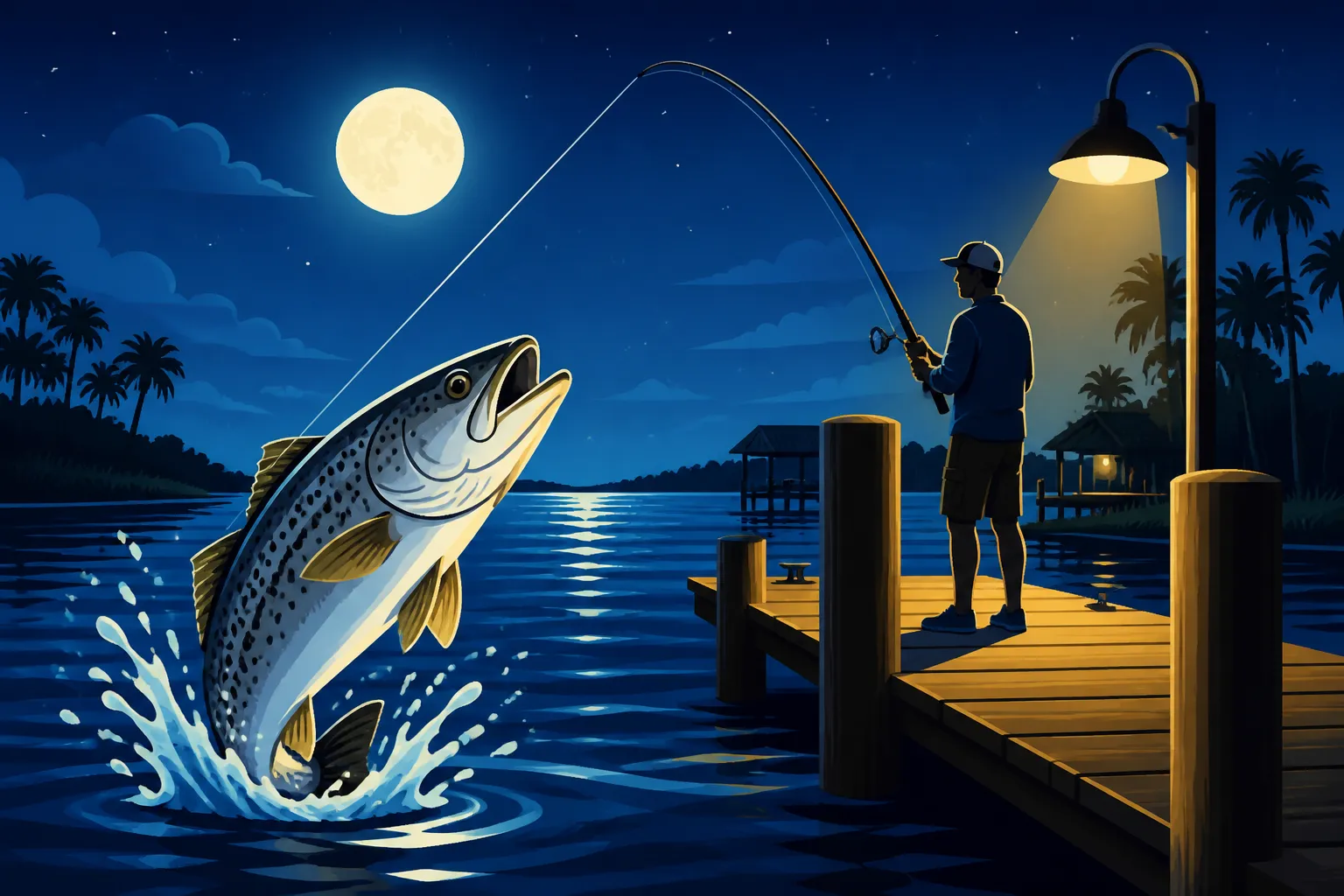
Imagine the scene: the air is cooler, the sounds of boat traffic have dwindled to an occasional distant hum, and the only light comes from a solitary dock lamp casting a golden glow on the water. Suddenly, a splash! A school of baitfish erupts as a trout slashes through them. This isn't just about catching fish; it's about being immersed in the nocturnal rhythm of the river, witnessing nature's drama unfold. Plus, you’re often avoiding the daytime crowds and the intense Florida sun, making for a much more comfortable angling session.
Common Frustrations and How to Overcome Them
Night fishing isn't without its challenges, and anyone who's tried it knows these frustrations well. One of the biggest is visibility. Trying to tie knots, re-rig, or even identify what you've caught can be a real struggle in the dark. That's why a good headlamp with a red-light option (to preserve night vision) is an absolute must-have. Another common issue is mosquitoes and other biting insects, which can turn a peaceful evening into an itchy nightmare. Always, and I mean always, bring strong insect repellent.
Beyond the practical annoyances, finding the right dock can be tricky. Not all docks are created equal for night fishing. Many beginners simply cast aimlessly around any illuminated area, but successful night anglers understand that trout often hold in specific zones around the light – typically on the edges where the light meets the dark, or just downstream of the current. You also might struggle with identifying bites, as they can sometimes be subtle in the dark. Paying close attention to your line and using sensitive rods can help. Don't let these minor hurdles deter you; with the right preparation and knowledge, you can easily overcome them and focus on the thrill of the catch. For a broader understanding of when the fish are biting, consider checking out resources on the Best Time of Day to Fish in Florida.
Identifying Productive Docks for Night Trout Fishing
Not just any dock will do when you're targeting spotted seatrout after dark. A truly productive dock on the St. Johns River for night fishing has a specific combination of features that attract both bait and predator. Knowing what to look for can save you hours of fruitless casting and put you right where the action is.
The Allure of Artificial Light
The single most critical factor for night trout fishing from a dock is light. But it's not just about any light; it's about the quality and placement of the light. Docks with submerged green or white lights are often goldmines. These underwater lights illuminate the water column, drawing in plankton, which then attracts small baitfish, and inevitably, larger predatory fish like spotted seatrout. The best lights are those that penetrate the water clearly, creating a distinct halo effect.
If you don't have access to docks with dedicated underwater lights, overhead dock lights can still be effective. They illuminate the surface, and fish will often cruise just outside the brightest area, picking off bait that ventures too close. Look for lights that have been on for a while, as this allows the baitfish to congregate. Transient lights that are constantly turning on and off are less productive because the ecosystem doesn't have time to establish itself. A steady light source is what creates a consistent feeding opportunity for the trout.
Submerged Structure and Current Breaks
Beyond the lights, the presence of submerged structure and current breaks is paramount. Spotted seatrout love to ambush their prey, and structure provides them the perfect hiding spots. This could be anything from the dock pilings themselves, to oyster beds, rock piles, or even sunken debris near the dock. These structures offer cover and a place for the trout to conserve energy while waiting for an easy meal. When combined with light, structure becomes an irresistible magnet.
Current is another vital component, especially on a tidal river like the lower St. Johns. Trout prefer areas where the current brings food to them, but they also appreciate a break in the current where they can sit and wait without expending too much energy. Docks that create a natural eddy or slack water pocket on one side, while still having moving water on the other, are often highly productive. This combination allows baitfish to get swept in, while trout can comfortably hold in the calmer water, darting out to strike. Understanding the Best Tides for Inshore Fishing in Florida will be crucial here, as tidal flow directly impacts current.
Bait Presence and Water Quality
Ultimately, a dock is only as good as the bait it holds. Even with perfect lights and structure, if there's no bait, there will be no trout. Before you even cast a line, take a few minutes to observe the water. Are there signs of baitfish? Look for small splashes, dimples on the surface, or the flickering reflections of tiny fish under the lights. If you can, use a small cast net to confirm the presence of glass minnows, shrimp, or finger mullet. No bait, no trout – it’s that simple.
Water quality also plays a significant role. Clearer water, while sometimes making fish warier, allows the light to penetrate deeper and attracts more bait. However, trout are often quite comfortable in slightly turbid or tannic water as well, which is common in many parts of the St. Johns. What you want to avoid is heavily polluted or stagnant water. The St. Johns River is a dynamic system, and choosing a dock on a healthy, active stretch of the river, where the water is moving and vibrant, will greatly increase your chances of success. A great way to scout locations and even book a trip with local experts who know these docks inside and out is through platforms like FishingBooker, which connects anglers with experienced guides in various parts of Florida.
| Dock Feature | Why It's Good for Night Trout Fishing | What to Look For |
|---|---|---|
| Consistent Light | Attracts baitfish, then trout. | Submerged green/white lights, steady overhead lamps. |
| Submerged Structure | Provides ambush points and cover. | Pilings, oyster beds, rock piles, sunken logs. |
| Current Breaks/Eddies | Allows trout to hold comfortably. | Downstream side of pilings, corners, coves near the dock. |
| Bait Presence | Essential food source for trout. | Splashing, dimples, visible schools of small fish. |
| Water Quality | Healthy ecosystem supports fish. | Clear to slightly tannic, moving water, no strong odors. |
Top Docks and Areas to Explore on the St. Johns River
The St. Johns River is immense, stretching over 310 miles, so pinpointing exact "best docks" can be challenging due to private access and constantly changing conditions. However, we can identify general regions and types of public access points along the lower, brackish sections of the river that consistently offer excellent opportunities for night fishing for spotted seatrout. Remember, the key is to look for those characteristics we just discussed within these areas.
The Lower St. Johns: Jacksonville and Surrounding Areas
As you move closer to the Atlantic Ocean, the St. Johns River becomes a tidal estuary, a perfect habitat for spotted seatrout. Jacksonville boasts numerous public parks and boat ramps along the river that often include docks suitable for night fishing. Areas like the Jacksonville Riverwalk, while often busy, can have illuminated sections that attract bait. More secluded spots in residential areas like Mandarin, Doctors Lake (a large tributary of the St. Johns, offering similar brackish conditions), and parts of Orange Park often have private docks that you might spot from the water if you're out scouting, or public access points with fishing piers nearby.
Mandarin Park, for instance, offers public access and sometimes has smaller, less crowded docks where local anglers have success. The key here is proximity to the main river channel and tidal flow. Docks located near deeper channels or grass flats will be more productive. Keep an eye out for any public fishing piers or jetties that extend into the river; these are essentially super-sized docks designed for anglers. These locations are excellent for practicing specific techniques outlined in our Night Fishing Technique for Trout Under Dock Lights guide.
Central St. Johns: From Palatka to Sanford
Moving south from Jacksonville, the St. Johns River slowly transitions from a predominantly brackish environment to more freshwater. However, areas around Palatka, Green Cove Springs, and further south towards Lake Monroe near Sanford can still hold impressive numbers of spotted seatrout, especially in the winter months when they push further upstream to find warmer water. These areas are characterized by more natural shorelines, but public boat ramps and marinas often have docks that light up at night.
In Palatka, the riverfront area and public boat ramps can be good starting points. Similarly, near Sanford, the Lake Monroe area, where the St. Johns widens into a lake, has marinas and public docks. While the salinity here is much lower, spotted seatrout are known to tolerate a wide range of salinities and can be found far upriver. These locations might require a bit more scouting to find the right combination of light and structure, but the rewards can be substantial. Remember that for any fishing in Florida, it's always wise to check the current Florida Fishing Regulations and Bag Limits for your target species.
Using Resources to Find Your Next Spot
Finding the perfect night fishing dock often comes down to local knowledge and some dedicated scouting. Websites and apps like FishingBooker can be incredibly valuable here, not just for booking charters but also for looking at popular fishing areas and reading reviews from other anglers. These platforms sometimes highlight specific productive spots or offer insights into what local guides consider prime locations. Additionally, talking to local tackle shop owners is an invaluable resource. They live and breathe the local fishing scene and can offer real-time advice on what docks are producing. Don't be shy; most tackle shop staff are happy to share their knowledge with fellow anglers.
Beyond that, simply driving or boating along the river at night, observing which docks are well-lit and seem to be attracting bait, can be a great way to discover new spots. Just be respectful of private property and always confirm public access before setting up your gear.
Essential Gear and Techniques for Night Dock Trout Fishing
Once you’ve identified a promising dock, having the right gear and knowing the best techniques will turn potential into successful catches. Night fishing has its own specific demands, and being prepared is half the battle.
Rods, Reels, and Line for Dock Fishing
For spotted seatrout, especially when fishing from docks, a light to medium-light spinning rod and reel setup is ideal. A 7-foot rod with a fast action tip will give you excellent casting accuracy, sensitivity to feel subtle bites, and enough backbone to fight a decent trout. Pair this with a 2500 or 3000 series spinning reel spooled with 10-15 pound braided line. The braid offers incredible sensitivity, which is crucial for feeling those faint taps in the dark.
Because trout have excellent eyesight, even at night, and braided line can be visible, you'll want to use a fluorocarbon leader. A 2-3 foot section of 15-20 pound fluorocarbon leader tied to your main braid with a strong knot (like an FG or Alberto knot) will give you that stealth factor. The leader also provides abrasion resistance against dock pilings and the trout's small, sharp teeth. This setup is perfectly aligned with what's generally recommended in a Best Rod and Reel Setup for Florida Inshore Fishing.
Baits and Lures That Shine in the Dark
When it comes to bait, live shrimp are almost always king for night trout fishing. They are a natural food source for trout, and their natural movements under dock lights are irresistible. Hook them through the horn or the tail, depending on how you want them to swim. Live finger mullet or pilchards, if available, are also fantastic choices. You can easily catch these with a How to Cast Net for Live Bait tutorial if you're prepared.
For artificial lures, consider soft plastic paddle tail or jerk baits in natural colors (like "new penny" or "chartreuse with glitter") rigged on a light jig head (1/8 to 1/4 ounce). Glow-in-the-dark lures can also be highly effective, especially for fish holding just outside the main light. Another excellent option, particularly if you see active feeding on the surface, is a topwater lure. Walk-the-dog style baits or poppers can trigger explosive strikes that are exhilarating to experience at night. For more specific recommendations, our Best Bait for Trout Fishing in Florida guide offers extensive details.
Techniques for Maximum Success
The primary technique for night fishing under dock lights is to cast parallel to the dock, or just beyond the edge of the light into the darkness, and retrieve your bait or lure through the transition zone. Trout often position themselves where the light meets the dark, ambushing anything that swims through the illuminated area. Don't cast directly into the brightest part of the light initially; work the edges first.
A slow, steady retrieve with occasional twitches or pauses is often best for soft plastics. If using live shrimp, a simple popping cork rig or free-lining them with a small split shot can be deadly. Pay close attention to your line, as bites can sometimes feel like a subtle "tick" or simply added weight. When you feel a bite, set the hook firmly but not violently, as trout have somewhat delicate mouths.
Remember to keep your own light discipline in mind. While your headlamp is essential for rigging, try to avoid shining it directly into the water for extended periods, as this can spook fish. Use the red light setting when possible. And finally, when landing a fish, be gentle. Many anglers practice catch and release with larger trout to help conserve the population, using techniques found in articles like Catch and Release Best Practices for Snook which apply to trout too.
Safety and Etiquette for Night Fishing
Night fishing, while rewarding, requires extra attention to safety and etiquette. Being out on the water or docks after dark presents unique challenges, and a little forethought can ensure a safe and enjoyable experience for everyone.
Essential Safety Gear and Precautions
Visibility is significantly reduced at night, making personal safety paramount. Always tell someone where you are going and when you expect to return. Never fish alone if possible, especially if you're exploring new areas. A fully charged cell phone is a non-negotiable item, and consider carrying a portable power bank. As mentioned, a reliable headlamp with fresh batteries (and spares!) is crucial for rigging, baiting, and navigating.
Beyond light, consider personal floatation devices (PFDs) if you're fishing from a boat or kayak, even if you’re just docked. Slips and falls are more common in the dark. A small first-aid kit for minor cuts or hook punctures is also a smart addition to your tackle bag. Bug spray is vital, not just for comfort but to prevent insect-borne illnesses. Finally, if fishing near boat traffic, make sure you have appropriate navigation lights on your vessel.
Respecting Private Property and Other Anglers
Many productive docks are on private property. Always ensure you have permission before fishing from a private dock. If you’re using a public dock that’s adjacent to private residences, be mindful of noise levels. Keep voices down, avoid loud music, and ensure your lighting doesn’t intrude on people’s homes. What might seem like a quiet evening for you could be disruptive to someone trying to sleep.
When other anglers are present, maintain a respectful distance and be mindful of casting lines across theirs. If someone is already fishing a particular section of a dock, try to find another spot. Communication is key – a friendly "How's it biting?" can go a long way in establishing a good rapport. Remember that fishing is often a peaceful pastime, and respecting fellow enthusiasts and their space contributes to a positive environment for everyone. FishingBooker also encourages respectful angling practices, so keep that in mind when planning your outings.
Navigating the St. Johns River After Dark
If you’re using a boat to access docks or move between spots, navigating the St. Johns River at night requires extreme caution. The river, particularly in its narrower sections or where it branches into tributaries, can have numerous hazards that are easily missed in the dark. Shallow areas, oyster bars, submerged logs, and unmarked navigation aids can all pose serious risks. Always adhere to speed limits, especially in no-wake zones, and use your navigation lights properly. Having a reliable GPS and chart plotter is highly recommended, even if you know the area well during the day. Things look very different when the sun goes down. Knowing how far out State Waters vs Federal Waters Fishing Rules in Florida extend isn't as relevant for river fishing, but understanding local navigation rules is crucial.
Night fishing on the St. Johns can be an incredibly rewarding experience, offering solitude and the chance to target some truly impressive spotted seatrout. By prioritizing safety, respecting others, and understanding the unique demands of fishing after dark, you'll be well on your way to many memorable nights on the water.
Disclaimer
The information provided in this guide is for general informational purposes only. Fishing conditions, regulations, and access points can change frequently. Always consult the latest Florida Fish and Wildlife Conservation Commission (FWC) regulations before fishing and respect private property. Practice safe boating and fishing techniques.