How to Sight Fish for Tarpon on the Flats
There's nothing quite like the heart-stopping moment you spot a shimmering silver torpedo cruising silently across a shallow Florida flat. The sheer excitement, coupled with the pressure of making the perfect cast to such an intelligent and powerful fish, can be absolutely thrilling – and sometimes, a little intimidating! This guide is all about equipping you with the knowledge and techniques to successfully sight fish for tarpon on the flats, transforming those fleeting glimpses into unforgettable battles.
Understanding the Elusive Silver King
Tarpon, often called the "Silver King," are truly magnificent creatures that capture the imagination of every angler who targets them. Their power, acrobatics, and sheer size make them a bucket-list fish for many, and successfully catching one on the shallow flats is a crowning achievement. But to do so, you first need to understand their behavior and why sight fishing is the ultimate strategy for these wary giants.
Why Sight Fishing Tarpon is Different
Unlike blindly casting into an area you think might hold fish, sight fishing for tarpon on the flats is a deliberate, visual hunt. You're actively scanning the water, looking for subtle signs of their presence before making a cast. This isn't just a preference; it's often a necessity. Tarpon on the flats are incredibly spooky. They're in shallow water, exposed to predators from above and below, making them acutely aware of their surroundings. A misplaced cast, a noisy approach, or even just standing up too quickly can send an entire school scattering, leaving you frustrated and empty-handed.
The challenge lies in their keen senses. Tarpon have excellent eyesight, especially when looking up or across the water, and they are highly sensitive to vibrations. This means you need to be stealthy, precise, and patient. It's a game of chess where you're trying to outsmart a fish that often feels like it knows your every move. It demands a heightened sense of awareness and a completely different approach than, say, throwing a crankbait for bass in a murky pond. When you're targeting tarpon, especially during the peak of the Florida Tarpon Fishing Season Guide, every detail matters.
Ideal Conditions for Sight Fishing
For a successful day of sight fishing for tarpon, you need a combination of factors to align perfectly. Think of it as a delicate balance where each element plays a crucial role in improving your chances of spotting and hooking a fish.
First and foremost, light is paramount. You need high sun to penetrate the water, allowing your polarized sunglasses to cut through the glare and reveal the fish below. Overcast days or early morning/late evening hours can make spotting tarpon incredibly difficult, if not impossible, especially when they're not rolling on the surface. Bright, sunny days between 10 AM and 4 PM are generally considered prime time for sight fishing on the flats. This is why knowing the Best Time of Year to Fish in Florida for tarpon often coincides with clear skies.
Next, water clarity is absolutely critical. Murky or turbid water renders sight fishing impossible. You need clear, clean water where you can see the bottom, or at least several feet down, to spot the fish. Areas prone to heavy boat traffic, recent storms, or significant algae blooms might not be suitable. This is where researching specific locations and checking local conditions becomes invaluable.
Finally, wind plays a surprisingly significant role. While a completely calm day might seem ideal, a light breeze is often preferred. A slight ripple on the water's surface can break up your silhouette, making it harder for tarpon to see you. Too much wind, however, creates chop that makes spotting fish extremely difficult and can also impede casting accuracy. A steady, light breeze, often referred to as a "tarpon chop," is what many seasoned anglers hope for when they're out on the hunt.
Essential Gear and Tackle for Flats Tarpon
Successfully landing a tarpon on the flats is a feat that requires not just skill, but also the right equipment. These fish are notorious for their explosive runs, acrobatic jumps, and raw power, so your gear needs to be up to the challenge. Skimping on tackle here is a recipe for heartbreak.
Rods, Reels, and Lines
When it comes to rods and reels for flats tarpon, you're looking for strength and durability.
For fly fishing, a 10- to 12-weight rod is the standard. A 10-weight is often used for smaller tarpon or when conditions are extremely calm and a more delicate presentation is needed, while an 11- or 12-weight is preferred for larger fish or when dealing with wind. The rod needs to have enough backbone to cast large flies into the wind and handle the powerful fight of a tarpon. Pair this with a high-quality, large-arbor fly reel that has a smooth, powerful drag system and capacity for at least 200-250 yards of 30-pound backing. Fly lines designed for tropical saltwater are essential, as they handle the heat without becoming sticky and retain their casting properties. A weight-forward floating line is typical, but intermediate or sinking tip lines might be used in specific situations. Don't forget a strong leader system, typically starting with a 60-80 lb butt section, tapering down to a 20 lb class tippet, and then a heavy bite tippet (60-80 lb fluorocarbon) directly to the fly. For more on this, check out our guide on Fly Fishing for Florida Tarpon.
For spinning gear, you'll want a medium-heavy to heavy action rod, typically 7 to 8 feet long, capable of handling 20-50 lb braided line. This rod needs to have enough sensitivity to feel subtle bites but also the power to set the hook and turn a strong fish. Match this with a robust spinning reel, sized around 6000-8000 series, with an exceptional drag system and plenty of line capacity. Spool it with 30-50 lb braided line, which offers incredible strength and sensitivity for its diameter. The lack of stretch in braid also aids in hook sets. Your leader should be 60-80 lb fluorocarbon, about 3-5 feet long, tied to the braid with a strong knot like an FG or Alberto knot.
Flies and Lures: Matching the Hatch and Beyond
Tarpon on the flats can be incredibly finicky, sometimes ignoring everything you throw at them. Other times, they'll eat aggressively. Having a selection of proven flies and lures is key.
For fly anglers, classic tarpon patterns are your bread and butter. The "Toad" fly, in various colors like black and purple, chartreuse, or tan, is a consistent producer. The "Tarpon Bunny" or "Black Death" are also popular choices. For fish that are rolling or showing interest in surface activity, a "Gurgler" or other popper-style fly can be exciting. The key is to have flies in different sizes and weights to match conditions and fish behavior. Sometimes a smaller, sparsely tied fly is the ticket; other times, a big, juicy pattern will get their attention.
When using spinning tackle, soft plastic paddle tails or jerk baits are highly effective. Brands like DOA, Z-Man, and Saltwater Assassin offer a wide range of colors and sizes. Darker colors like black and purple often work well in clearer water, while chartreuse or white can be good in slightly stained conditions. Jig heads from 1/8 to 3/8 ounce are typically used to get the lure down but still allow for a slow, subtle retrieve. Small, weedless soft plastic jerk baits can also be incredibly effective, rigged weightless or with a small worm hook. Hard-bodied plugs like MirrOlures or Rapalas can work, especially when tarpon are feeding on baitfish, but they require a more aggressive presentation which can sometimes spook wary fish on the flats.
Essential Accessories
Beyond the core tackle, a few essential accessories can make or break your tarpon flats fishing experience. These items aren't just convenient; they're often crucial for success and safety.
First, and arguably most important, are high-quality polarized sunglasses. You simply cannot sight fish effectively without them. They cut the glare off the water, allowing you to see into the water column and spot fish that would otherwise be invisible. Invest in a good pair – brands like Costa Del Mar or Maui Jim are favorites among serious anglers, and you can often find a good selection of quality polarized lenses on Amazon. Different lens colors (e.g., amber, copper, green mirror) are designed for varying light conditions, so consider what works best for the bright Florida sun.
A wide-brimmed hat and liberal application of sunscreen are also non-negotiable. The sun reflecting off the water on the flats can be intense, leading to severe sunburn and heat exhaustion if you're not protected. Lightweight, long-sleeved fishing shirts with UPF protection are also highly recommended. Again, Amazon has a huge range of options for sun protection apparel.
If you're fly fishing, a stripping basket worn around your waist can be incredibly helpful, especially when wading or when the wind is gusty. It keeps your fly line from tangling around your feet, hooks, or boat components, ensuring a clean cast when that precious tarpon appears.
Lastly, don't forget a camera to capture the memories! A waterproof action camera or a phone in a waterproof case is perfect for documenting those incredible jumps and successful releases. A pair of heavy-duty line clippers and a dehooking tool are also vital for quick, safe releases, minimizing stress on the fish.
Mastering the Art of the Approach and Presentation
Spotting a tarpon is only half the battle; the real test comes in how you approach the fish and present your fly or lure. This is where stealth, precision, and an understanding of tarpon behavior truly come into play. A perfect cast can result in a hook-up; a poor one will send the fish fleeing in a flash.
Spotting Tarpon on the Flats
Developing an "eye" for tarpon takes practice, but there are distinct signs to look for. It's rarely about seeing the whole fish in crystal-clear water; more often, it's about interpreting subtle cues.
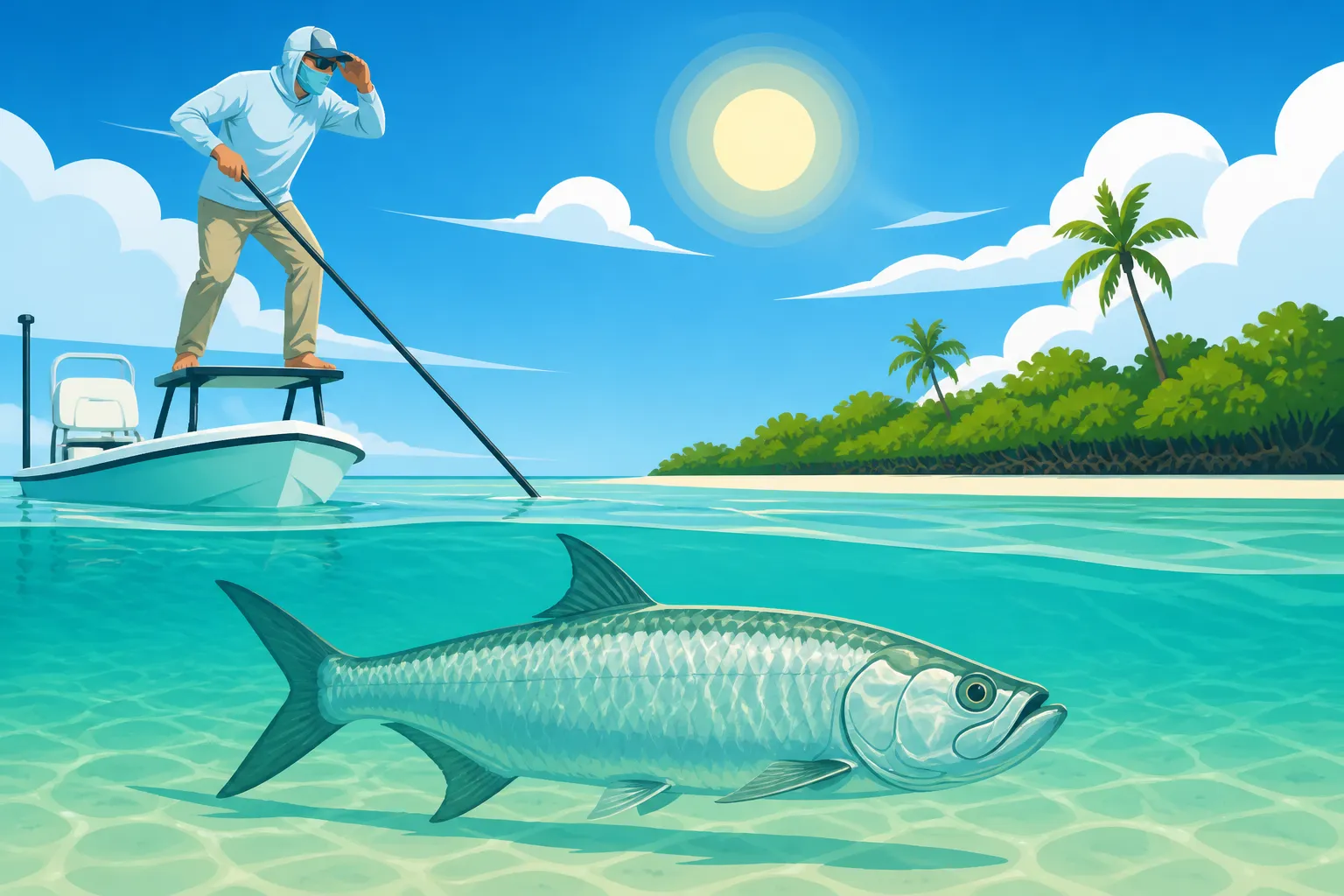
One of the most common ways to spot tarpon is by seeing their shadows. In shallow water, a large fish will cast a distinct shadow on the bottom, often appearing darker and more defined than the fish itself. Train your eyes to look for these moving shadows. Another dead giveaway is "pushing water." As a tarpon moves through very shallow water, it displaces water, creating a V-wake or bulge on the surface. This is particularly noticeable on calm days.
Sometimes, you'll see the fish rolling or "gulping." Tarpon have a swim bladder that functions like a lung, allowing them to gulp air at the surface, especially in oxygen-depleted waters or when they're actively feeding. This brief flash of silver or the distinct "pop" on the surface is an unmistakable sign. Finally, look for subtle fins: a dorsal fin or tail tip breaking the surface, or even just a flash of silver as they turn. Remember, the sun's position is key – you generally want the sun at your back or shoulder to illuminate the water ahead and reduce glare. Being on an elevated platform, like a poling skiff's tower or a casting platform on a bay boat, greatly enhances your visibility. This is especially true when exploring areas like the Best Flats Around Islamorada for Sight Fishing, where the water is often crystal clear.
Stealth and Positioning
Once you spot a tarpon, your next moves are critical. Stealth is paramount. Avoid sudden movements, loud noises, or dropping anything on the boat deck. The slightest vibration can spook these sensitive fish. If you're on a poling skiff, the guide will be silently poling the boat into position, minimizing disturbance. If you're wading, move slowly and deliberately, keeping your footsteps soft.
Positioning is equally important. You want to get into a position that allows for a comfortable, accurate cast that leads the fish without landing directly on its head. Consider the wind direction – casting into a strong headwind is tough, while a slight tailwind can assist with distance and presentation. Also, think about the current. Tarpon often swim into the current, and you want to present your fly or lure ahead of them, allowing it to drift naturally into their strike zone. A general rule of thumb is to aim for a presentation that gives the fish time to see and react to your offering, typically 10-15 feet ahead of their path, and slightly to the side. Never cast directly at the fish, as the splash will almost certainly send them rocketing away.
The Perfect Cast and Retrieve
Executing the perfect cast to a moving tarpon on the flats is often considered one of the pinnacles of flats fishing. It requires accuracy, speed, and delicacy. For fly anglers, a double-haul cast is often necessary to generate the line speed and distance needed, especially in windy conditions. The goal is to lay the fly down softly, without a loud splash, several feet in front of and to the side of the fish.
The retrieve is just as crucial as the cast. Tarpon are predators, but they can be surprisingly finicky. For flies, a series of short, quick strips often mimics a fleeing baitfish or shrimp. Sometimes a longer, slower strip is more effective. The key is to watch the fish's reaction. If it turns its head or flares its gills, that's a sign you're doing something right. If it ignores the fly or spooks, adjust your retrieve. For lures, a slow, steady retrieve with occasional twitches can be deadly. Often, a "stop and go" retrieve, where you pause the lure for a second or two, can trigger a strike from a hesitant tarpon. Remember, you're trying to make your offering look alive and irresistible.
Common mistakes include casting too close to the fish, landing the fly or lure too hard, and retrieving too quickly or too slowly. It takes time and patience to learn the nuances of tarpon presentation, but when you get it right, the reward is incredible.
Fighting and Releasing the Silver King
Once you've made that perfect cast and a tarpon decides to eat, get ready for an adrenaline rush like no other. Fighting a tarpon is a test of strength, skill, and sometimes, sheer willpower. And just as important as the fight is ensuring a healthy release, as these magnificent fish are primarily a catch-and-release species.
The Battle of a Lifetime
When a tarpon eats your fly or lure, the first thing you'll experience is often a sudden, powerful strike. Set the hook hard and repeatedly, especially with fly tackle. Once hooked, the real battle begins. Tarpon are famous for their spectacular aerial acrobatics. They will jump, thrash, and try to throw the hook with violent head shakes. This is where the crucial "bow to the king" technique comes in.
As soon as the tarpon jumps, you need to quickly lower your rod tip, pointing it directly at the fish, creating slack in the line. This prevents the fish from breaking your leader or line on the jump and reduces the leverage it has to throw the hook. As it re-enters the water, immediately raise your rod and reel down to regain tension. This quick dance of bowing and reeling is repeated with every jump and is absolutely essential for keeping the fish on. Our guide on How to Fight a Tarpon on Light Tackle delves into this in even more detail.
Maintain constant, heavy pressure on the fish throughout the fight. Tarpon have incredibly tough mouths, and a strong, steady pull is needed to keep the hook set. Be prepared for blistering runs that can strip hundreds of yards of line off your reel in seconds. Use your body weight and the rod's leverage to steer the fish, trying to keep it from running into structure or deep water where sharks might be lurking. The fight can last anywhere from 10 minutes to over an hour, depending on the size of the fish and your tackle. It's a true test of endurance for both angler and gear.
Responsible Handling and Release
Tarpon are a highly valued sport fish, and in Florida, they are predominantly a catch-and-release species. This means responsible handling and a healthy release are not just good practice but a legal and ethical imperative. In fact, if you're interested in whether Is Tarpon Good to Eat?, you'll quickly learn that most anglers release them due to their status and the sporting challenge they present.
Once you've fought the tarpon to the boat and it's subdued, minimize handling as much as possible. If a photograph is desired, try to keep the fish in the water, supporting its belly with one hand while holding the lower jaw with the other. Never lift a large tarpon vertically by its jaw, as this can cause severe damage to its internal organs. Avoid dragging the fish onto the boat or beaching it unless absolutely necessary.
The most critical part of the release is ensuring the fish is fully revived before letting it go. Hold the tarpon gently by the lower jaw, pointing its head into the current or moving it slowly forward and backward to force water over its gills. This helps to oxygenate its blood. Look for strong, steady kicks of its tail and signs that it's able to hold itself upright. Once it shows strong signs of recovery and tries to swim away vigorously, gently release it. This process is similar to Catch and Release Best Practices for Snook and other large game fish. If the fight was exceptionally long, take extra time for resuscitation. Adhering to Florida Fishing Regulations and Bag Limits regarding tarpon also means understanding the specific rules around their harvest, which typically requires a Tarpon Tag for any fish you intend to possess or kill, although recreational anglers rarely do.
Taking these steps ensures that the Silver King can swim away strong, ready to fight another day and contribute to future generations of this iconic Florida fish.
| Feature / Aspect | Fly Fishing for Tarpon | Spin Fishing for Tarpon |
|---|---|---|
| Primary Appeal | Challenge, precision, "pure" angling | Power, versatility, ease of casting |
| Rod Weight/Action | 10-12 weight, fast action | Medium-heavy to heavy action, 7-8 ft |
| Reel Type | Large arbor, strong, smooth drag, 200-250+ yds backing | 6000-8000 series, powerful drag, high line capacity |
| Line Type | Weight-forward floating tropical fly line | 30-50 lb braided line |
| Leader/Tippet | Tapered leader (60-20 lb), 60-80 lb bite tippet | 60-80 lb fluorocarbon (3-5 ft) |
| Baits/Lures | Tarpon flies (Toad, Bunny, Gurgler, Cockroach) | Soft plastics (paddle tails, jerk baits), plugs |
| Casting Skill Required | High (double haul, accuracy, presentation) | Moderate (distance, accuracy, softer entry) |
| Wind Impact | Significant, can hinder casting | Less impactful, but still a factor |
| Learning Curve | Steep | Moderate |
| Overall Experience | Highly engaging, visual, direct connection | Powerful, often more forgiving on presentation |
Disclaimer
Fishing involves inherent risks, including but not limited to adverse weather conditions, marine life encounters, and equipment malfunction. Always prioritize safety, wear appropriate personal flotation devices when on the water, and be aware of your surroundings. Regulations regarding fishing licenses, seasons, bag limits, and gear can change. It is your responsibility to consult the latest Florida Fish and Wildlife Conservation Commission (FWC) guidelines before any fishing trip. The information provided in this guide is for general informational purposes only and should not be considered a substitute for professional advice or current regulatory requirements.