How to Fight a Tarpon on Light Tackle
Ah, the majestic tarpon! There's arguably no fish in Florida that combines raw power, acrobatic flair, and sheer size quite like the "Silver King." But when you decide to chase these incredible creatures on light tackle, you're signing up for a true test of skill, patience, and endurance. Many an angler has felt that heartbreaking snap of a line or the crushing disappointment of a pulled hook after a magnificent jump, especially when battling a behemoth on lighter gear. This guide is all about equipping you with the strategies and mindset to successfully fight a tarpon on light tackle, turning those frustrations into triumphant, albeit exhausting, memories.
Understanding the Tarpon on Light Tackle
Fishing for tarpon is an experience unlike any other, and doing it with light tackle elevates the challenge and the reward exponentially. It's a dance between angler and fish where every move counts.
Why Light Tackle Poses a Challenge
Let's be real: tarpon are built like aquatic gladiators. They're dense, muscular, and famous for their lightning-fast runs and spectacular, aerial acrobatics. When a 100-pound tarpon leaps out of the water, shaking its head violently, the forces exerted on your line and tackle are immense. With traditional heavy gear, you have a bit more forgiveness, a wider margin for error. But with light tackle, that margin shrinks significantly. It's easy to feel utterly outmatched, as if you brought a butter knife to a sword fight. This is where many anglers get into trouble, trying to muscle the fish, which often results in a quick defeat and a broken spirit – and sometimes, a broken rod tip!
The struggle isn't just about the initial burst of energy. Tarpon have incredibly hard, bony mouths, making a solid hook set difficult, and their abrasive scales can quickly wear through a leader. Coupled with their sheer stamina, a light tackle fight can easily stretch into an hour or more, testing every fiber of your being. This is why understanding their behavior and having a well-thought-out strategy is crucial, because simply reacting in the moment often leads to failure.
Defining "Light Tackle" for Tarpon
When we talk about "light tackle" for tarpon, we're not talking about panfish gear. Tarpon can grow well over six feet long and exceed 200 pounds, so "light" is a relative term. For many seasoned Florida anglers, light tackle for tarpon generally refers to a setup that would typically be used for much smaller saltwater game fish, pushing the limits of the gear. This usually means spinning or conventional setups spooled with 20 to 30-pound braided main line, often with a 40 to 60-pound fluorocarbon leader.
Compared to heavy conventional gear, which might utilize 50-80 pound mono or braid and a heavier leader, light tackle feels incredibly nimble. It allows for longer, more accurate casts and often leads to a more exciting, drawn-out battle. While the lighter line and leader definitely increase the chances of a break-off, they also require the angler to employ more finesse, strategic angling, and a deeper understanding of drag management. Many anglers prefer this challenge because of the incredible satisfaction that comes with besting such a powerful fish on seemingly inadequate gear.
Essential Gear Setup for the Fight
Having the right gear is the foundation for any successful tarpon fight, especially when you're going light. It's not just about strength; it's about balance, sensitivity, and reliability.
Rod and Reel Selection
When choosing your rod for light tackle tarpon, you're looking for a delicate balance. You need a rod with enough backbone to really put pressure on a big fish, but also a forgiving tip that can cast lighter baits or lures and absorb the shock of those explosive head shakes. A medium-heavy to heavy power spinning or baitcasting rod, typically between 7 and 8 feet in length, with a fast or extra-fast action tip is ideal. The fast action tip helps with accurate casting and feeling subtle bites, while the solid backbone closer to the reel provides the leverage needed to turn a charging tarpon.
Your reel, however, is arguably the most critical component. It needs a butter-smooth, consistently performing drag system capable of handling long, blistering runs without stuttering or seizing. A sticky drag is a death sentence in a light tackle tarpon fight, leading to snapped lines or pulled hooks. Look for reels designed for heavy saltwater use, even if you're going with a smaller size class. A good quality reel with at least 20 pounds of smooth drag is a must. You can find excellent options on platforms like Amazon, but always prioritize reviews focusing on drag performance and durability in saltwater conditions. A high gear ratio isn't always necessary; a strong retrieve and reliable drag are more important than speed.
Line, Leader, and Knots
The choice of line is paramount. For your main line, braided line is almost universally preferred for light tackle tarpon fishing. Its incredible strength-to-diameter ratio means you can spool a lot of 20 to 30-pound test braid onto your reel, giving you the capacity needed for those long runs. More importantly, braid offers superior sensitivity, allowing you to feel every head shake and subtle change in the fish's direction, and zero stretch, which translates into powerful, direct hook sets, crucial when dealing with a tarpon's bony mouth.
Connecting that braid to your leader is where many battles are won or lost. You absolutely need a strong, abrasion-resistant fluorocarbon leader. Tarpon's rough scales and sharp gill plates can slice through monofilament in an instant. A 40 to 60-pound test fluorocarbon leader, typically 6 to 8 feet long, provides a critical buffer. The connection knot between your braid and fluorocarbon leader must be impeccable – knots like the FG knot or modified Albright are highly recommended for their strength and slim profile. For attaching your hook or lure to the leader, a strong improved clinch knot or a snell knot are reliable choices. Remember, every knot is a potential weak point, so practice them until they're perfect. Our guide on What Pound Test Line for Tarpon Fishing goes into more detail about these crucial choices.
The Art of the Hook Set and Initial Run
The moment a tarpon takes your bait or lure is just the beginning of the real challenge. The hook set and initial run require immediate, precise actions to avoid an early heartbreak.
The "Bow to the King" Technique
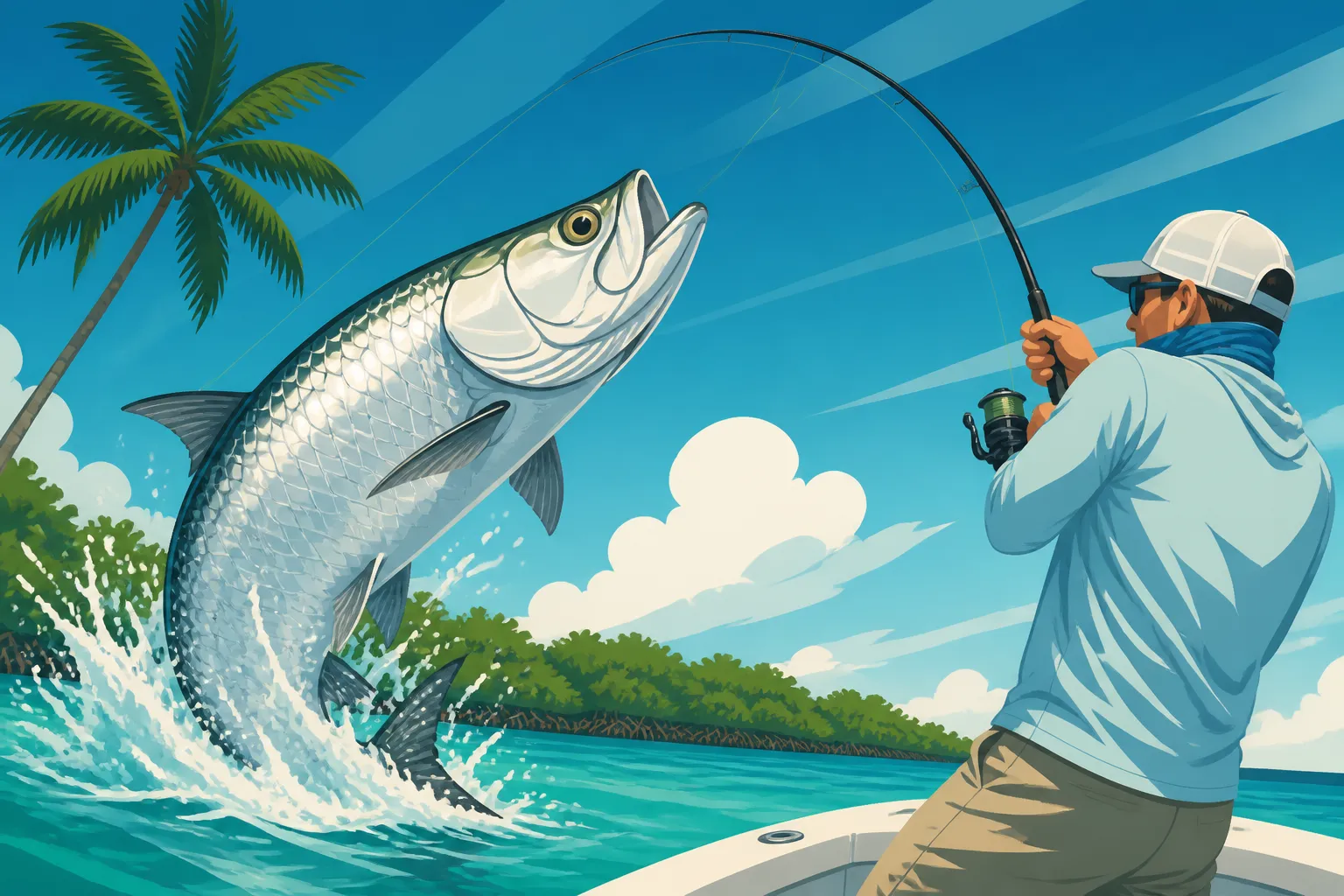
This technique is perhaps the single most important lesson any tarpon angler can learn, especially when fishing with light tackle. When a tarpon jumps – and they will jump, often multiple times – the absolute worst thing you can do is maintain a tight line. As the fish throws its head and body out of the water, any tension on the line creates a pivot point, often leading to the hook pulling free or, worse, your line snapping under the sudden, violent strain. This is particularly true with the unforgiving nature of braid and lighter leaders.
Instead, the moment you see the fish break the surface and start its aerial display, you must "bow to the king." This means quickly lowering your rod tip towards the fish, creating slack in the line. This momentary slack prevents the fish from leveraging the line against its body or mouth to throw the hook. Once the tarpon splashes back down, immediately lift your rod tip and start reeling furiously to regain tension. It sounds counterintuitive to give a powerful fish slack, but it's a proven method that saves countless hook sets. Master this, and your chances of landing a tarpon on light tackle will skyrocket.
Managing the First Explosive Run
Once hooked, a tarpon's first reaction is almost always an explosive, line-peeling run. This is where your reel's smooth drag system earns its keep. The critical mistake many anglers make is trying to stop this initial run by tightening the drag or putting a thumb on the spool. On light tackle, this is a surefire way to snap your line. Instead, let the fish run. Your drag should be set to provide steady, consistent pressure, allowing the fish to take line but tiring it out in the process.
Maintain a consistent rod angle, typically around 45 degrees, to allow the rod's flex to absorb the shocks and lunges of the fish. Avoid pointing the rod directly at the fish, as this takes the shock-absorbing properties of the rod out of the equation. Keep a close eye on your line, ensuring it's not rubbing against any obstacles like boat motors, buoys, or even other fishing lines if you're fishing in a group. Constant vigilance and maintaining the right pressure without overdoing it are the keys to surviving this initial, brutal burst of power. This is when you realize why many refer to them as the Best Fighting Fish in Florida Saltwater.
The Mid-Fight Strategy and Endurance
Once the initial chaos subsides, the fight settles into a grueling test of wills. This is where your technique and stamina come into play, especially when you're battling a large tarpon on light gear.
Pumping and Reeling
To gain line on a powerful fish like a tarpon, you can't just reel constantly. You'll quickly tire yourself out and put immense strain on your gear. The effective technique is "pumping and reeling." Here's how it works:
- Lift the rod: With your rod pointing towards the fish, smoothly but firmly lift the rod tip from roughly a 45-degree angle up to about a 70-80 degree angle. This action, using the rod's leverage, pulls the fish towards you, gaining a few feet of line.
- Reel down: As you lower the rod tip back to the 45-degree position, quickly reel in the slack line you've just gained. The key is to reel only on the downward stroke, maintaining constant tension on the fish.
- Repeat: Continuously repeat this motion – lift, reel down, lift, reel down. This rhythmic process allows you to gain line efficiently without constantly cranking against the fish's full power. It lets the rod do the heavy lifting, saving your arms and back.
Avoid the urge to "horse" the fish, pulling with all your might. On light tackle, this will almost certainly result in a break-off. It's a marathon, not a sprint. Remember to stay hydrated and take short breaks if your arms start to burn. Even a minute of resting can rejuvenate your muscles for the long haul.
Handling Jumps and Head Shakes
Tarpon are notorious for their spectacular jumps throughout the fight, not just at the beginning. Each jump is another critical moment that can determine success or failure. Always be ready to "bow to the king" every single time the fish goes airborne. It's an instinct you must develop. Keep your eyes on the fish, and the instant it clears the water, drop your rod tip and feed slack. Don't resume reeling until it's back in the water and settled.
Closer to the boat, tarpon often engage in powerful head shakes, trying to dislodge the hook. During these moments, it's crucial to maintain constant, firm pressure. Keep your rod tip up and pointed towards the fish, allowing the rod's flex to absorb the shocks. Avoid jerking or snatching, which can tear the hook out of their tough mouth. Anticipate their moves; if the fish starts to swim towards you, reel quickly to take up slack. If it tries to run under the boat, move quickly to follow it, keeping the line clear of the hull or motor. Managing these frantic close-quarters maneuvers is a hallmark of a skilled light tackle angler. If you're using a guide, they'll often help you with boat positioning, as detailed in our Florida Tarpon Fishing Guide.
The Crucial Endgame and Release
After a long, arduous battle, the tarpon starts to tire. This is not the time to relax; the endgame is often the most critical phase, where mistakes can still cost you the fish.
Guiding the Tarpon to the Boat
As the tarpon begins to show signs of exhaustion – perhaps it's rolling at the surface, swimming slower, or making less powerful runs – your job shifts from merely holding on to actively guiding it towards the boat. This isn't about brute force; it's about steering the fish. Use your rod to "lead" the fish, turning its head towards the boat when possible. If it wants to run to the left, try to angle your rod to encourage it to turn right, disrupting its momentum.
Pay meticulous attention to the line as the fish gets closer. Even a tired tarpon has one last burst of energy, and it might try to dive under the boat, wrap around the motor, or head for structure like mangroves. Stay mobile, move around the boat as needed, and ensure your line remains clear. This is also when having a good boat captain who can maneuver the vessel to keep you in an optimal fighting position becomes invaluable. Always keep that rod tip up and pressure on, ready for one last surge.
Safe Handling and Release Practices
For most recreational anglers, tarpon are a catch-and-release species, treasured for their sporting value rather than their culinary qualities. Proper handling is paramount to ensure the survival of these magnificent fish. Once the tarpon is alongside the boat, minimize its time out of the water. Avoid dragging it onto the deck or lifting it vertically by the head, as this can severely damage its internal organs and jaw.
Ideally, use a dehooking tool to remove the hook while the fish is still in the water, especially if the hook set is shallow. If you need to bring it aboard for a quick photo, use a lip-gripper to secure its jaw and support its belly with your other hand. Never hold a large tarpon purely by the jaw. Keep it horizontal and get your photos quickly, within seconds, not minutes.
Before releasing, spend time reviving the fish. Hold it gently by the tail and lip-grippers, with its head pointed into the current. Move it back and forth to force water over its gills until it regains its strength and can swim away under its own power. You'll feel a strong tail kick when it's ready. The satisfaction of watching a healthy tarpon swim away strongly after a hard-fought battle on light tackle is truly the ultimate reward. You can learn more about responsible fishing in guides like Catch and Release Best Practices for Snook, many principles of which apply to tarpon.
Comparative Look: Light Tackle vs. Heavy Tackle for Tarpon
To further illustrate the unique challenges and rewards of light tackle tarpon fishing, let's consider how it stacks up against traditional heavy tackle.
| Feature | Light Tackle (e.g., 20-30 lb braid) | Heavy Tackle (e.g., 50-80 lb braid/mono) |
|---|---|---|
| Line Class | 20-30 lb braid (main), 40-60 lb fluorocarbon (leader) | 50-80 lb braid/mono (main), 80-150 lb fluorocarbon (leader) |
| Rod Type | Medium-heavy to Heavy, 7-8 ft, fast action spin/baitcast | Heavy to Extra-Heavy, 6-7 ft, moderate to fast action conventional |
| Reel Drag | 15-25 lbs (smooth, consistent) | 25-40+ lbs (powerful, robust) |
| Fight Duration | Often 30 minutes to 1.5+ hours | Typically 15-45 minutes |
| Casting Range | Longer, more accurate casts | Shorter, less precise casts, more for brute force |
| Angler Fatigue | High, requires significant stamina and technique | Moderate to High, still demanding |
| Challenge Level | Very High | High |
| Reward Feeling | Immense satisfaction, truly earned | Great satisfaction, efficient fight |
| Break-off Risk | Higher, due to thinner lines and less shock absorption | Lower, more forgiving |
As you can see, light tackle fishing for tarpon is a commitment. It demands more from the angler in terms of skill, patience, and physical exertion, but the experience and the sense of accomplishment are truly unparalleled. While heavy tackle gets the job done more efficiently, light tackle offers a more intimate and challenging engagement with one of Florida's most iconic game fish.
Remember, whether you're stalking them on the flats or finding them rolling in the passes, ensure you have the appropriate Florida Saltwater Fishing License Rules in mind, as well as any specific permits like a Florida Snook Permit Requirements if you happen to target them incidentally. Good luck out there, and may your drag sing a sweet, smooth tune!
Disclaimer
This article is for general informational purposes only and does not constitute professional advice. Laws, prices and regulations vary by location and change over time. Consult a qualified professional for guidance on your specific situation.