How to Rig a Live Shrimp for Trout
There's nothing quite like the thrill of a speckled trout strike, especially when you're fishing the beautiful inshore waters of Florida. But let's be honest, sometimes getting those elusive specks to bite feels like a real puzzle. You've got your rod, your reel, and even a bucket of frisky live shrimp, but are you presenting that bait in a way that makes it absolutely irresistible? This guide is going to meticulously walk you through everything you need to know about rigging live shrimp for trout in Florida, ensuring your bait looks so natural, those clever spotted seatrout won't be able to resist.
Understanding Your Target: Florida Spotted Seatrout
Before we even talk about hooks and lines, it’s crucial to understand the magnificent fish we’re targeting: the Florida spotted seatrout. These aren't just any fish; they're apex predators in the inshore ecosystem, known for their ambush tactics and preference for certain types of prey. Knowing their habits will dramatically improve your rigging choices and overall success.
Why Live Shrimp Are the Ultimate Trout Bait
If you've spent any time fishing in Florida's inshore waters, you know that shrimp are the backbone of the entire food chain. From tiny glass minnows to juvenile snook, almost everything eats shrimp. For spotted seatrout, a live, wiggling shrimp is essentially a guaranteed meal ticket. They're a natural food source, highly abundant in the grass flats, mangrove edges, and oyster bars where trout love to lurk. A struggling, vulnerable shrimp perfectly mimics what a trout naturally preys on, making it incredibly effective. The erratic movements, the subtle vibrations, and even the scent of a live shrimp are all powerful attractants that artificial lures simply can't always replicate with the same consistency. It’s their naturalness that makes them so hard for a hungry trout to pass up.
What Trout Look for in a Meal
Spotted seatrout are visual feeders, but they also rely on vibrations and scent, especially in murky water or low light. When a trout sees a shrimp, it's looking for vulnerability. A shrimp that's swimming naturally, but perhaps a little "off" – slightly wounded, disoriented, or just plain easy to catch – is a prime target. They often prefer to ambush their prey rather than chase it down, so a shrimp hovering enticingly near a grass patch or slowly drifting through a channel is much more appealing than one darting away frantically. This is why proper rigging is so critical. You want your shrimp to look alive and natural, but also a tad vulnerable, signaling an easy meal to the trout. They're not looking for a marathon, they're looking for a quick snack. If your shrimp is constantly spinning or swimming unnaturally due to poor rigging, it can actually deter a savvy trout.
Essential Gear for Rigging Live Shrimp
Having the right tackle makes all the difference when you're trying to present a live shrimp delicately and effectively. Heavy gear will spook fish and hinder your presentation, while gear that's too light might leave you heartbroken when a trophy trout decides to make a run for it.
Rod and Reel Selection for Light Tackle
For spotted seatrout and live shrimp, you're generally going to want a light to medium-light spinning rod, typically in the 7-foot range. A fast action rod tip is ideal because it allows for delicate presentations and quick, responsive hook sets, but still has enough backbone to fight a decent fish. Graphite rods are fantastic for this because they are lightweight and incredibly sensitive, allowing you to feel even the most subtle taps from a trout. Pair this with a lightweight spinning reel in the 2500-3000 size class. Brands like Shimano, Daiwa, or Penn offer excellent options that are durable and have smooth drags, which are essential for preventing line breaks when a big trout makes a sudden run. A good reel will also help with casting accuracy and distance, especially when you need to quietly drop a shrimp into a tight pocket of grass. For more details on ideal setups, check out our guide on the Best Rod and Reel Setup for Florida Inshore Fishing.
Line, Leader, and Hook Choices
Your line choice is critical for both sensitivity and stealth. Many anglers opt for braided line as their main line, typically 10-15 pound test. Braid has virtually no stretch, which means you'll feel every bump and nibble, and its thin diameter allows for longer casts. However, braid is visible in clear water, so you absolutely need a fluorocarbon leader. A 2-3 foot section of 15-20 pound fluorocarbon leader is usually perfect. Fluorocarbon is nearly invisible underwater and has excellent abrasion resistance, which is important when fishing around oyster bars or rocky areas. You can find quality fluorocarbon leader material from brands like Seaguar or Berkley on Amazon.
Now, for hooks, this is where many people go wrong. You want a hook that's strong but also light enough not to impede the shrimp's natural movement. Circle hooks are often preferred because they are designed to hook the fish in the corner of the mouth, reducing gut-hooking and making catch-and-release much easier, which is vital for preserving the trout population. A size 1 or 1/0 circle hook is usually ideal for average-sized live shrimp. If your shrimp are particularly large, you might go up to a 2/0, but try to keep it as small as possible. Offset circle hooks are popular as they provide a better hookup ratio. Look for quality hooks from reputable brands like Gamakatsu or Owner, which are readily available on Amazon. The sharpness of the hook is paramount; a dull hook will lead to missed bites and frustrated anglers.
Terminal Tackle: Corks, Weights, and Swivels
Depending on your rigging method, you might need additional terminal tackle.
- Corks (Floats): Popping corks are incredibly effective for trout. These specialized floats have a concave top that, when popped, creates a "chugging" sound that mimics a feeding fish or a shrimp flicking its tail. This commotion attracts trout from a distance. Cigar floats, which are slender and stationary, are great for a more subtle presentation when you just want to suspend your bait at a specific depth without much noise. The size of your cork should match the size of your shrimp and the weight of your hook; too big, and it'll look unnatural; too small, and it won't float your bait properly.
- Weights (Sinkers): In most live shrimp scenarios for trout, you want as little weight as possible. Often, the weight of the hook is enough. However, if you're fishing in a strong current or need to get your shrimp down faster, a small split shot or pinch-on weight might be necessary. Use the absolute lightest weight you can get away with. A 1/16 or 1/8 ounce split shot is usually sufficient. Place it about 12-18 inches above your hook on the leader.
- Swivels: A small, high-quality barrel swivel (size 10-12) can be used to connect your braided main line to your fluorocarbon leader. This prevents line twist, which can be a real nuisance, especially when using popping corks or casting repeatedly. Ensure it's a small swivel to maintain stealth.
Step-by-Step: Rigging Live Shrimp for Optimal Presentation
Now for the main event: how to actually get that lively shrimp onto your hook without killing it or making it look like a tragic accident. There are a few primary methods, each with its own advantages depending on the fishing scenario.
The "Horn" Rig: Best for Natural Movement
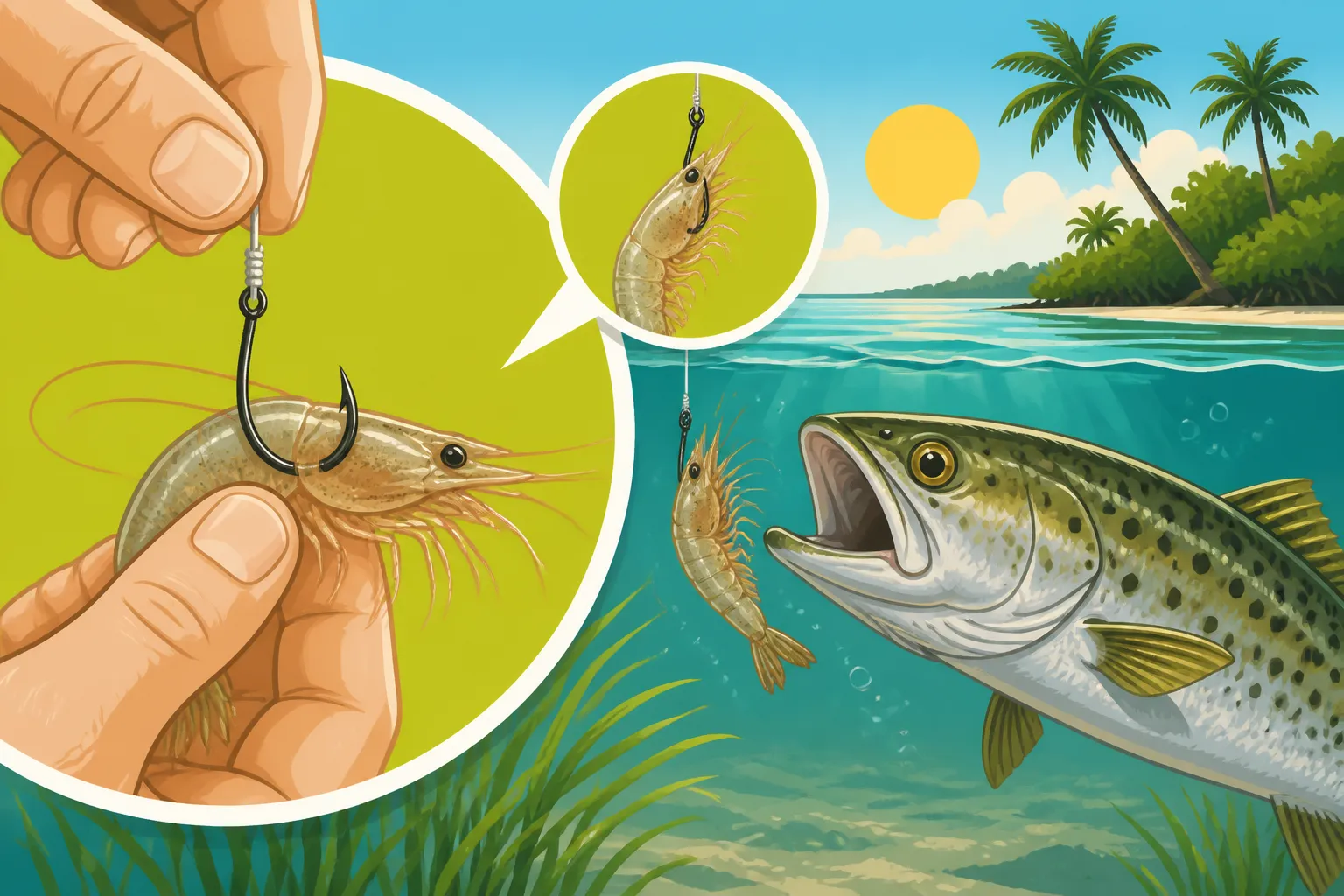
This is arguably the most common and effective way to rig a live shrimp for trout, especially when you want maximum natural movement. The key here is to pass the hook through the shrimp's head, but above its brain, which is located in the dark spot near its eyes.
- Preparation: Gently pick up your live shrimp. Try to handle it as little as possible to keep it lively.
- Hook Placement: Locate the hard "horn" or rostrum on top of the shrimp's head. Just behind this horn, and slightly below it, you'll see a small, clear spot. This is where you want to insert your hook.
- The Hook-Up: Carefully push the point of your circle hook through this clear spot, coming out on the opposite side. The hook should pass through a tough, cartilaginous part of the shrimp's head.
- Verification: Ensure the hook is clear of the shrimp's brain (the dark spot) and its vital organs. The shrimp should still be wiggling its tail and antennae vigorously. If it stops moving or starts curling up, you've likely hit a vital spot, and it's best to re-bait.
Why it works: Rigging through the horn allows the shrimp to swim and kick naturally, making it incredibly enticing to a trout. The hook is less likely to kill the shrimp quickly, maximizing its action time. This method is fantastic when free-lining or fishing under a popping cork in calm waters where a natural presentation is key. The shrimp can kick, dive, and dart, looking like an easy meal. This is a go-to for many anglers pursuing spotted seatrout, especially in clear, shallow grass flats.
The "Tail" Rig: For Casting Distance and Durability
Sometimes you need to cast a little further, or your shrimp are getting ripped off the hook too easily by smaller bait stealers. That's when the tail rig comes in handy. It’s also often used when fishing for larger species like redfish or snook that have a more aggressive strike.
- Preparation: Again, handle your shrimp gently.
- Tail Fan Removal (Optional but Recommended): For maximum effectiveness and to prevent the shrimp from swimming backwards away from your target area, some anglers will pinch off the very end of the tail fan. This creates a small wound that releases scent and makes the shrimp appear more distressed, while also stopping its backward propulsion.
- Hook Placement: Insert the hook through the last segment of the shrimp's tail, just before the tail fan. Push the hook through the top (dorsal side) and out the bottom (ventral side).
- Verification: The shrimp should still be alive and kicking, though its movement will be more limited than with a horn rig.
Why it works: Rigging through the tail provides a very secure attachment, allowing for more aggressive casting without the shrimp flying off. It's also more durable, resisting the pecks of smaller fish. While the shrimp’s movement is somewhat restricted, the exposed meat from pinching the tail fan can release scent, which is another powerful attractant. This method is excellent when you need to cover more ground, fish in areas with current, or if you're getting short-strikes on the head-rigged shrimp. It’s a good choice for targeting trout from a boat when you're drifting and making longer casts across expansive flats.
Under a Popping Cork: Creating Irresistible Commotion
Fishing a live shrimp under a popping cork is a classic Florida inshore technique, especially effective for spotted seatrout and redfish. The cork acts as both an attractor and a strike indicator.
- Rigging the Cork: First, tie your popping cork onto your main line, typically with a leader of 18-36 inches (or more, depending on water depth) extending from the bottom of the cork to your hook. Ensure your leader length allows the shrimp to suspend just above the grass or structure where trout are likely to be. Many anglers use a small swivel between the cork's leader and the hook leader.
- Attach the Shrimp: Rig your live shrimp using either the "horn" or "tail" method as described above. The horn rig often provides the most natural action under a cork.
- Casting and Popping: Cast your rig out, letting it settle. Then, give your rod tip a sharp, downward jerk. This makes the popping cork "chug" or "pop," creating an irresistible splash and gurgle.
- Retrieval: After the pop, let the rig sit for a few seconds, allowing the shrimp to flutter naturally. Repeat the pop-and-pause sequence as you slowly retrieve the rig.
Why it works: The popping sound simulates a feeding frenzy or a baitfish struggling on the surface, drawing the attention of predatory trout. The shrimp suspended below, wiggling enticingly, is then an easy target. This method allows you to cover large areas of grass flats, working productive zones systematically. When the cork goes down, set the hook! It's one of the most exciting ways to fish for trout, and the audible cue of the pop attracts fish from a surprising distance. This technique is particularly effective over shallow grass flats or near oyster bars. For more general advice on how to improve your inshore fishing, consider reading about Florida Inshore Fishing Techniques.
Free-Lining: The Stealthy Approach
When the water is exceptionally clear, or the fish are particularly spooky, free-lining a live shrimp can be the most effective strategy. This method uses no weight or cork, allowing the shrimp to drift as naturally as possible.
- Minimal Rigging: Simply tie your fluorocarbon leader directly to your main line (or use a tiny swivel) and then tie your hook to the end of the leader.
- Attach the Shrimp: Rig your live shrimp through the horn for the most natural drift.
- Casting and Drifting: Cast your shrimp up-current or up-wind of your target area (e.g., a pothole in a grass flat, a mangrove point, or a channel edge). Let the current or wind carry the shrimp naturally, slowly paying out line as it drifts.
- Maintain Contact: Keep your rod tip high and maintain a slight bow in your line to feel for subtle bites. The key is to let the shrimp do all the work, mimicking a truly free-swimming or injured bait.
Why it works: Free-lining is the most natural presentation possible. There's no artificial sound or splash, just a vulnerable shrimp drifting freely. This is especially effective for wary trout in clear, calm conditions. The challenge is feeling the bite, as it can be very subtle. A trout will often just inhale the shrimp, and you'll feel a slight pressure or a "tick" on your line. It's a fantastic technique for sight fishing on shallow flats where trout might be cruising. You can explore how the moon and tides affect this technique in our article on the Best Tides for Inshore Fishing in Florida.
Mastering the Presentation: Fishing Your Live Shrimp
Rigging your shrimp is only half the battle. How you present it, where you cast it, and how you react to a bite are equally important for consistent success.
Reading the Water and Finding Trout Hotspots
Florida's waters are teeming with life, but trout aren't everywhere. They congregate in specific areas that offer food, shelter, and ambush points.
- Grass Flats: These are prime trout habitat. Look for potholes (sandy patches within the grass) where trout can lie in wait.
- Oyster Bars: These structures provide excellent ambush points and food sources. Fish the edges and any cuts through the bars.
- Mangrove Edges: Trout will often position themselves along mangrove lines, waiting for bait to be flushed out by the tide.
- Channels and Cuts: Deeper channels or cuts between flats can hold larger trout, especially during colder months or lower tides.
- Moving Water: Trout prefer areas with good tidal flow, as this brings food to them. Focus on areas where currents create eddies or funnels.
- Depth and Temperature: In cooler months, trout might move to slightly deeper water or dark-bottomed areas that absorb more heat. In warmer months, they might seek out slightly deeper, cooler spots or shady areas.
- Light: Low light conditions (dawn, dusk, overcast days) are often the best times to target trout, as they become more active hunters. Our guide on the Best Time of Day to Fish in Florida can give you more insights.
When you're on the water, pay attention to baitfish activity. If you see schools of bait, trout are likely not far behind. Also, keep an eye out for bird activity, like diving pelicans, which often indicates baitfish below.
Casting and Retrieval Techniques
Your casting and retrieval should be as quiet and natural as possible.
- Stealthy Casting: Avoid making big splashes when your bait hits the water, especially in shallow, clear conditions. A gentle lob or a sidearm cast can place your shrimp softly.
- Working the Popping Cork: As mentioned, a sharp, downward twitch of the rod tip will make the cork pop. The cadence is crucial: pop-pause-pop-pause. Experiment with the length of the pause; sometimes a longer pause allows the shrimp to flutter down and entice a wary trout.
- Free-Line Retrieval: This isn't really a "retrieval" in the traditional sense. It's more about managing your line to allow the shrimp to drift naturally. Keep a slight bow in your line to allow for the drift, but not so much slack that you can't feel a bite. Reel in just enough slack to maintain that subtle connection.
- Variable Retrieval: Don't be afraid to experiment. Sometimes a slow, steady retrieve is best, other times a stop-and-go. The key is to make your shrimp look like it's trying to get away, but not succeeding too well. The more natural the movement, the better.
Understanding the Bite and Setting the Hook
Trout bites can range from a subtle "tick" to a hard, aggressive thump.
- Popping Cork Bites: This is the easiest to detect. The cork will either suddenly disappear under the water, or it will start to move horizontally at an unnatural speed. When this happens, reel down to remove any slack and then sweep your rod tip to the side or up to set the hook firmly. Don't yank too hard, as a circle hook does most of the work itself.
- Free-Line Bites: These are often more subtle. You might feel a light "tap," a sudden pressure, or your line might just start to move in a different direction. With a circle hook, resist the urge to rear back and set the hook like you would with a J-hook. Instead, when you feel the bite, simply reel down smoothly until your line is tight and then sweep the rod to the side. The circle hook will naturally turn and embed itself in the corner of the trout's mouth.
- Fighting the Fish: Trout have relatively soft mouths, so a smooth, consistent drag setting is important. Avoid horsing the fish in, as hooks can pull out easily. Keep steady pressure and enjoy the fight! Once you've landed your trout, if you plan to release it, handle it carefully. You can learn more about proper fish handling in our guide on Catch and Release Best Practices for Snook, which apply well to trout too. Don't forget, you'll need a Florida Fishing License Guide before you even cast a line.
Tips for Keeping Your Live Shrimp Lively
A dying or dead shrimp isn't nearly as effective as a lively one. Keeping your bait frisky throughout your fishing trip is paramount to success.
Aeration and Water Quality
Live shrimp need oxygen, just like any other living creature.
- Aerated Bait Bucket: Invest in a good quality bait bucket with a battery-powered aerator. Brands like Engel, Frabill, or even simple bubblers available on Amazon are excellent choices. This will continuously oxygenate the water, keeping your shrimp lively for hours.
- Water Temperature: Shrimp are sensitive to temperature changes. Try to keep your bait water at a stable temperature, ideally close to the water temperature where you're fishing. Avoid direct sunlight, and if fishing on a hot day, you might consider adding a frozen water bottle (not ice, as chlorine in tap ice can harm them) to slowly cool the water.
- Water Changes: If your water gets murky or dirty, change it out with fresh saltwater from the fishing grounds. Don't use chlorinated tap water! A few partial water changes throughout the day can make a big difference.
- Overcrowding: Don't put too many shrimp in one bucket. Overcrowding depletes oxygen faster and stresses the shrimp, making them die quicker. Give them space to swim.
Handling Your Shrimp with Care
Every time you handle a shrimp, you risk injuring it, which reduces its appeal to a trout.
- Gentle Touch: Use a small bait net or scoop to retrieve shrimp from your bucket, rather than grabbing them with your hands. This minimizes physical trauma.
- Quick Rigging: Rig your shrimp swiftly and efficiently. The less time it spends out of the water, the better.
- Avoid Contaminants: Ensure your hands are clean and free of sunscreen, bug spray, or any other chemicals before handling your bait. These foreign substances can be transferred to the shrimp and deter fish.
- Discarding Dead Shrimp: If a shrimp dies, remove it from the bait bucket immediately. Dead shrimp decompose rapidly and can foul the water, harming the remaining live bait.
Keeping your shrimp lively isn't just about convenience; it's a critical component of successful live bait fishing. A healthy, active shrimp is a beacon for hungry trout, drastically increasing your chances of a memorable catch.
Rigging Live Shrimp for Trout: A Quick Comparison
| Rigging Method | Ideal Scenario | Pros | Cons |
|---|---|---|---|
| Horn Rig | Calm, clear water; free-lining; popping cork | Maximum natural movement; high appeal | Less durable for casting; easier for small fish to steal bait |
| Tail Rig | Strong currents; longer casts; bait stealers | Very secure; good for aggressive casting; durable | Less natural movement; can kill shrimp faster if not careful |
| Popping Cork | Shallow grass flats; searching large areas | Attracts fish from afar; visual strike indicator | Less stealthy; requires active rod manipulation |
| Free-Lining | Clear, calm water; spooky fish; sight fishing | Most natural presentation; highly stealthy | Difficult to detect bites; challenging in current or wind |
Disclaimer
Fishing regulations, including license requirements, bag limits, and seasons, can change frequently. Always consult the latest rules and regulations from the Florida Fish and Wildlife Conservation Commission (FWC) before heading out on the water. This guide is for informational purposes only and does not constitute legal advice.