Freshwater vs Saltwater Fishing Gear Differences
If you've ever walked into a tackle shop in Florida, you've probably noticed a bewildering array of fishing rods, reels, and accessories. It's easy to feel lost, wondering if that shiny new reel you use for bass will hold up against a feisty snook, or if your lightweight freshwater rod is tough enough for the open ocean. The truth is, while some basics cross over, there are crucial differences between freshwater and saltwater fishing gear, and understanding them can save you a lot of heartache (and broken tackle). This guide will break down exactly what sets the gear apart, helping you choose the right tools for your Florida adventures.
The Fundamental Divide: Why Gear Needs to Be Different
It might seem like a simple concept, but the stark contrast between freshwater and saltwater environments creates a massive demand for specialized fishing gear. It's not just about what kind of fish you're targeting; it's about the very elements working against your equipment. Ignoring these fundamental differences is a surefire way to quickly ruin expensive gear and have a frustrating day on the water.
The Corrosive Power of Saltwater
Imagine dipping your favorite car parts into a bath of saltwater every day. That's essentially what happens to your fishing gear when exposed to the ocean or even brackish estuaries. Saltwater is an incredibly corrosive environment, and it attacks metals, plastics, and even some lines with relentless ferocity. Freshwater, by comparison, is far more forgiving on materials.
When you use freshwater gear in saltwater, you'll quickly see the effects. Reel bearings can seize up, gears can become pitted and grind, and even the guides on your rod can start to rust and fray your line. A seemingly harmless splash or spray can initiate a slow, destructive process that reduces the lifespan of your equipment dramatically. This is why manufacturers go to great lengths to incorporate corrosion-resistant materials like anodized aluminum, stainless steel, and special protective coatings into saltwater-specific tackle. It’s not just a marketing gimmick; it's a necessity for longevity and reliable performance in Florida's vast saltwater fisheries. Without this protection, that expensive reel might only last a few trips before it becomes a paperweight.
The Strength and Size of the Fish
Florida boasts an incredible diversity of fish species, and generally speaking, many of our most popular saltwater game fish tend to be larger and put up a more powerful fight than their freshwater counterparts. Think about it: a typical largemouth bass, while a blast to catch, usually doesn't compare to the explosive runs of a snook or the sheer brute force of a tarpon. This difference in potential size and fighting prowess directly impacts the strength and durability required of your fishing gear.
When you're chasing the "silver king" (tarpon) in the Florida Keys or wrestling a big redfish out of the mangroves, you need rods with more backbone, reels with robust drag systems, and lines with higher breaking strengths. Freshwater gear, designed for lighter loads and less brutal battles, simply isn't up to the task. Using undersized or underpowered gear not only makes landing a trophy fish nearly impossible, but it also increases the risk of injuring the fish by prolonging the fight unnecessarily. It's about matching the tool to the job, and in saltwater, the job often demands heavy-duty performance. For example, if you're planning a trip targeting Florida Tarpon Fishing Season Guide, you’ll quickly find that your bass rod won't cut it.
Rods and Reels: Built for Battle or Finesse?
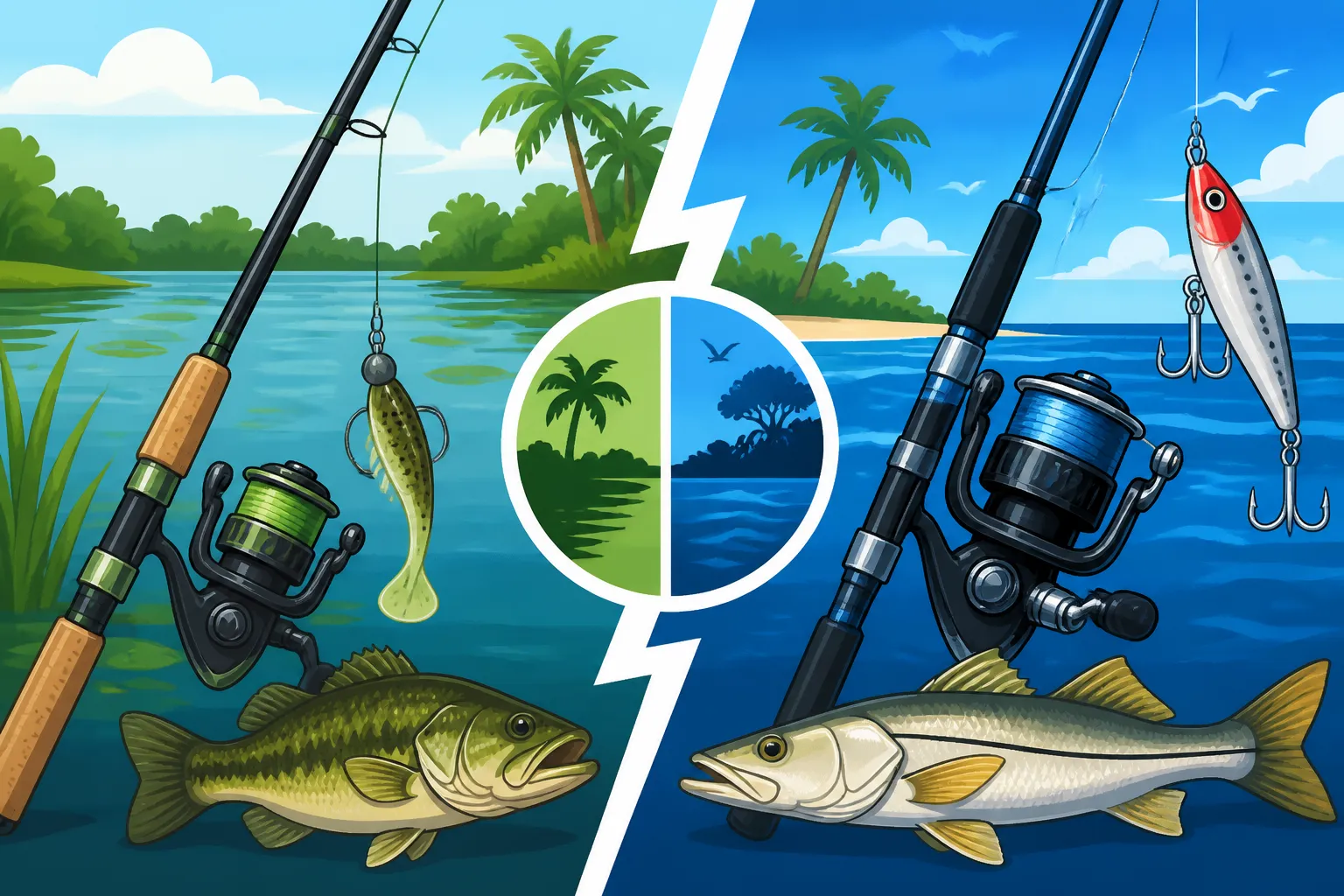
The most visible distinction between freshwater and saltwater fishing gear lies in the rods and reels. While they both serve the same basic function—casting and retrieving line, fighting fish—their construction and components differ significantly to withstand their respective environments and target species.
Freshwater Rods and Reels
Freshwater rods and reels are generally designed for lighter applications, emphasizing sensitivity, finesse, and lighter lines. You'll find these rods often made from lighter graphite composites, which provide excellent sensitivity for detecting subtle bites from species like crappie or bluegill, or for feeling the nuances of a soft plastic worm as you work it for bass. The actions tend to be faster, meaning the rod bends more in the tip section, which aids in accurate casting of lighter lures and quick hooksets.
Reels for freshwater, especially for species like Florida Largemouth Bass Fishing Guide, typically prioritize smooth operation and light weight. Spinning reels are incredibly popular for their ease of use and versatility, handling a wide range of lure weights. Baitcasting reels, on the other hand, offer superior casting accuracy and power for heavier lures and larger bass. The internal components of these reels are often made from aluminum, brass, or lighter alloys. While durable, they lack the intense corrosion resistance needed for saltwater, and their drag systems, while smooth, aren't always designed for the sustained, powerful runs of a big saltwater fish. Many anglers find great freshwater gear readily available through retailers like Amazon, perfect for a peaceful day on Lake Okeechobee.
Saltwater Rods and Reels
When you move to saltwater, the game changes entirely. Saltwater rods are constructed with a focus on strength and durability. You'll find a higher percentage of fiberglass in many offshore rods, providing immense lifting power, while inshore rods might still use graphite but with thicker walls and stronger components. Rod guides, often a weak point for corrosion, are typically made with stainless steel frames and ceramic inserts to withstand saltwater spray and the constant abrasion of heavier braided lines. The handles are also usually more robust, often featuring thicker EVA foam or cork for better grip and comfort during prolonged fights.
Saltwater reels are beasts of a different nature. They are built like tanks, designed to withstand immense pressure and the corrosive onslaught of the marine environment. Key features include:
- Corrosion-Resistant Materials: Expect extensive use of anodized aluminum, stainless steel, and specially treated alloys in the frame, spool, and internal components. Many reels are sealed to prevent saltwater intrusion into critical areas like bearings and drag washers.
- Powerful Drag Systems: Saltwater reels feature oversized, multi-disc drag systems made with materials like carbon fiber or ceramic, designed to dissipate heat and provide smooth, consistent stopping power against strong, fast-running fish like tuna or king mackerel. A quality drag is paramount when you're hooked into a hefty Florida Grouper Fishing Guide offshore.
- Gear Strength: Gears are made from stronger, heavier-duty metals to handle the increased torque and stress of fighting larger fish.
- Capacity: Spools are designed to hold much more line, often heavier braided line, to account for long runs from big game species.
Whether you're targeting Florida Snook Fishing Guide in the shallow inshore waters with a heavy-duty spinning reel or heading offshore for snapper with a powerful conventional reel, saltwater gear is engineered to endure. You can find a huge selection of purpose-built saltwater rods and reels on platforms like Amazon, from entry-level combos to professional-grade equipment.
Fishing Lines, Lures, and Terminal Tackle: Small Details, Big Impact
It's not just the big stuff like rods and reels; the smaller components you attach to your line are equally, if not more, critical when distinguishing between freshwater and saltwater applications. These are the "business end" of your fishing setup, and their appropriate selection can mean the difference between landing a fish of a lifetime and watching it swim away with your lure.
Line Choices
The fishing line itself is often overlooked but is a crucial area of difference.
-
Freshwater Lines: For freshwater, you typically see lighter test monofilament, fluorocarbon, or braided lines. Monofilament offers good stretch, knot strength, and is easy to handle, often used for panfish or lighter bass applications. Fluorocarbon is less visible underwater and has better abrasion resistance, making it ideal for clear water and finicky bass. Braided lines offer incredible strength-to-diameter ratios and no stretch, which is great for sensitivity and long casts in situations like targeting big bass in heavy cover. These lines typically range from 4-pound test for panfish up to 20-30 pound test for heavy bass setups.
-
Saltwater Lines: In saltwater, things get tougher. Braided line is king for main lines due to its extreme strength, minimal stretch, and resistance to abrasion from sharp shell beds, barnacle-encrusted structures, or rough fish mouths. You'll often see main lines in the 20-pound to 80-pound test range, or even heavier for offshore big game. Fluorocarbon is almost universally used as a leader material in saltwater because of its invisibility, excellent abrasion resistance, and stiffness, which helps prevent tangles. It's often used in heavier tests, from 20-pound up to 100-pound or more, depending on the target species. The sheer power of saltwater fish demands stronger line. Whether you're refreshing your spool for a Florida Redfish Fishing Guide trip or stocking up for offshore, remember that bulk spools of quality line are often available at competitive prices on Amazon.
Lures and Baits
While there's certainly crossover, the types and construction of lures also adapt to the environment.
-
Freshwater Lures: Freshwater lures tend to be lighter, smaller, and often feature treble hooks made from standard carbon steel. Soft plastic worms, finesse jigs, spinnerbaits, crankbaits, and topwater frogs are staples for bass fishing. They are designed to mimic insects, small baitfish, or amphibians found in freshwater ecosystems. The hooks, while sharp, are not typically built with the same level of corrosion resistance or brute strength as their saltwater counterparts.
-
Saltwater Lures: Saltwater lures are generally larger, heavier, and built with more robust components to withstand the environment and the fish. Metal jigs, heavy plugs, large soft plastics, and substantial spoons are common. The hooks on saltwater lures are almost always made from corrosion-resistant materials like stainless steel or strong bronze alloys, and they are typically much heavier gauge to handle powerful fish. Even the split rings and swivels on saltwater lures are upgraded for strength and corrosion resistance. You'll also find a much wider array of live bait rigs designed for various saltwater species, often utilizing circle hooks to minimize harm for catch and release. For specific species like Florida Spotted Seatrout Fishing Guide, lighter lures might be used, but still with saltwater-appropriate hooks.
Hooks, Swivels, and Leaders
This is where the fine details really matter, and skimping here is a common mistake for new saltwater anglers.
-
Freshwater Terminal Tackle: Hooks for freshwater are often smaller and finer, suitable for soft-mouthed fish or subtle presentations. They are typically made of high-carbon steel, which is very sharp but highly susceptible to rust in saltwater. Swivels are lighter duty, and leaders are often fluorocarbon in lighter tests or sometimes not used at all, depending on the clarity of the water and target species.
-
Saltwater Terminal Tackle: In saltwater, every piece of terminal tackle must be corrosion-resistant and incredibly strong.
- Hooks: Expect heavy-gauge, corrosion-resistant hooks (stainless steel or special alloys). These hooks are designed to withstand powerful bites and prolonged fights without bending or rusting into oblivion after a single use. Circle hooks are particularly popular for many saltwater species due to their effectiveness and ability to hook fish in the corner of the mouth, making for easier release.
- Swivels: Heavy-duty barrel swivels, ball-bearing swivels, or snap swivels made from brass, stainless steel, or black nickel are essential. They prevent line twist from fighting fish or trolling and need to hold up to immense strain.
- Leaders: Saltwater leaders are crucial. They serve several purposes: providing invisibility (fluorocarbon), abrasion resistance (from teeth, gills, or structure), and shock absorption. For toothy critters like king mackerel or barracuda, wire leaders are an absolute must to prevent bite-offs. Without a proper leader, even the strongest braided line is vulnerable. This is especially true when targeting aggressive fish like the ones found in the Florida Grouper Fishing Guide or Florida Snook Fishing Guide.
Other Essential Gear and Considerations
Beyond the core fishing tackle, other accessories and personal gear also show significant differences when you transition from freshwater to saltwater. These items are designed to improve your comfort, safety, and the overall efficiency of your fishing trip.
Nets, Pliers, and Other Accessories
Just like your rod and reel, the accessories you use for handling fish and tackle need to be adapted for the saltwater environment.
-
Nets: While a basic nylon net might work fine for a freshwater bass, it's often inadequate for larger, stronger saltwater species, and the netting can quickly degrade. Saltwater nets are typically larger, with heavier-duty frames and often feature rubber-coated mesh. The rubber coating helps prevent hooks from getting tangled, is gentler on a fish's slime coat for catch and release, and is more resistant to salt degradation. Trying to net a big redfish with a small freshwater net is a recipe for frustration and potentially a lost fish.
-
Pliers and De-hookers: This is a big one. Regular carbon steel pliers will rust into a solid block after just a few saltwater trips if not meticulously cleaned. Saltwater pliers are made from corrosion-resistant materials like anodized aluminum or stainless steel. They often have heavier jaws and specialized cutters for braided line and heavier wire. A good pair of saltwater pliers is invaluable for hook removal, cutting line, and general tackle adjustments. De-hookers, especially long ones, are also critical for safely removing hooks from toothy or venomous species without putting your hands near danger. Many anglers swear by specialized lip grippers for handling large, heavy saltwater fish, ensuring both angler and fish safety. You can find robust options for these essential tools on Amazon.
-
Storage: Tackle boxes and bags for saltwater use should ideally be made from durable, corrosion-resistant plastics or fabrics. Trays and compartments should be designed to keep saltwater spray out and allow for easy rinsing of gear.
Apparel and Protection
The Florida sun is intense, and whether you're fishing freshwater or saltwater, protection is paramount. However, saltwater fishing often involves longer exposure to open water, reflective surfaces, and less shade, making specific apparel choices even more critical.
-
Sun Protection: This is non-negotiable in Florida. Long-sleeve, breathable fishing shirts made from UPF-rated fabric are essential. Wide-brimmed hats, neck gaiters, and polarized sunglasses are also must-haves. Sunscreen should be applied liberally and frequently, especially on exposed skin. The glare off the water during a long day of Florida Offshore Fishing Techniques can be brutal without proper eye protection.
-
Footwear: For freshwater fishing from shore, a sturdy pair of boots or waterproof shoes might suffice. On a boat, however, especially in saltwater, non-marking, non-slip deck shoes or sandals are crucial for safety. The decks can get wet and slick with water, fish slime, or bait, and good traction prevents falls. Many popular boating shoes offer excellent grip and drain quickly.
-
Rain Gear: Florida's weather can change in an instant, especially during the summer months with afternoon thunderstorms. Lightweight, breathable rain gear is a smart investment for both freshwater and saltwater anglers to stay comfortable and dry. Being prepared for a sudden downpour can make the difference between an enjoyable day and a miserable one.
It’s clear that while the core act of fishing remains the same, the environment fundamentally alters the demands on your gear. Investing in the right tools, designed for the unique challenges of Florida's freshwater or saltwater habitats, will not only enhance your success but also ensure your equipment lasts for countless fishing adventures.
Freshwater vs. Saltwater Fishing Gear Comparison
To give you a quick visual summary, here's a table outlining the key differences between typical freshwater and saltwater fishing gear. Remember, there's always some overlap, but this guide should help you make informed decisions.
| Feature | Freshwater Fishing Gear | Saltwater Fishing Gear |
|---|---|---|
| Rods | Lighter graphite/composites, faster action, smaller guides. | Heavier graphite/fiberglass, stronger backbone, larger corrosion-resistant guides. |
| Reels | Lighter materials (aluminum, brass), less corrosion-resistant, moderate drag. | Heavy-duty alloys (anodized aluminum, stainless steel), sealed, powerful multi-disc drag. |
| Main Line | Monofilament, lighter fluorocarbon, braid (4-30 lb test). | Heavier braid (20-80+ lb test), stronger monofilament for some applications. |
| Leaders | Lighter fluorocarbon (if used), often not critical. | Heavier fluorocarbon for stealth/abrasion, wire for toothy fish. |
| Lures | Smaller, lighter, carbon steel hooks. | Larger, heavier, corrosion-resistant hooks (stainless, bronze). |
| Hooks | Carbon steel, smaller, lighter gauge. | Corrosion-resistant alloys (stainless, tinned), heavy gauge, robust. |
| Swivels | Lighter duty, standard barrel swivels. | Heavy-duty, ball-bearing, corrosion-resistant. |
| Pliers/Tools | Standard carbon steel, basic cutters. | Anodized aluminum/stainless steel, heavier jaws, braid cutters. |
| Nets | Smaller, nylon mesh. | Larger, heavier frame, rubber-coated mesh for durability and fish care. |
| Durability Focus | Sensitivity, lightweight, finesse. | Corrosion resistance, raw power, brute strength. |
Ultimately, understanding these distinctions is key to a successful and enjoyable fishing experience in Florida. Don't be that angler trying to pull a bull redfish out of a strong current with a flimsy bass rod! Take the time to assess your target species and environment, and you'll be well-equipped for whatever Florida's waters throw your way. If you're wondering Inshore vs Offshore Fishing in Florida Explained, the gear requirements will be very different!
Disclaimer
This article is for general informational purposes only and does not constitute professional advice. Laws, prices and regulations vary by location and change over time. Consult a qualified professional for guidance on your specific situation.